Quick Key Takeaways – Electrical Wiring and Rewiring
Comprehensive Rewiring and Aluminum Wire Remediation in Brighton
The electrical wiring concealed behind the finished drywall and plaster of your home is the circulatory system of your electrical infrastructure. Invisible to daily view, thousands of linear feet of insulated copper or aluminum conductors distribute 120-volt and 240-volt electrical power from your main service panel to every wall outlet, ceiling light, appliance, and heating circuit throughout your property.
However, electrical wiring does not last indefinitely. In Brighton, Colorado, the housing stock spans over a century of distinct construction eras. From early twentieth-century craftsman homes and farmhouses in Historic Downtown Brighton containing original ungrounded knob-and-tube wiring to mid-century ranch homes built during the 1960s and 1970s containing hazardous single-strand aluminum branch circuit wiring, older electrical systems present severe safety, insurance, and capacity challenges.
At Electrician Brighton CO, our field technicians specialize in Whole-Home Rewiring and Certified Aluminum Wire Remediation. Utilizing non-destructive wire fishing techniques through existing wall cavities, CPSC-approved permanent remediation hardware, and modern 2023 NEC-compliant copper NM-B Romex cable, we eliminate concealed fire hazards and modernize your home's electrical infrastructure for decades of safe, high-capacity living.
The Historical Timeline of Residential Wiring in Brighton
Understanding which wiring method was installed in your home is the first step in assessing safety and insurance compliance:
| Wiring Construction Era | Primary Wire Materials Used | Equipment Ground Present | Primary Safety and Operational Hazards |
|---|---|---|---|
| Pre-1950 (Historic Era) | Knob-and-Tube (Copper in Cotton/Tar Loom) | None (2-Wire Ungrounded System) | Brittle insulation; severe fire risk if covered by attic insulation |
| 1950 to 1965 (Early Mid-Century) | Early Cloth-Sheathed Non-Metallic (Romex) | None or Undersized (#16 AWG Ground) | Deteriorated cloth sheath; lack of equipment ground for electronics |
| 1965 to 1973 (Vietnam War Era) | Single-Strand Solid Aluminum Branch Wire | Present (Bare Aluminum Ground) | Extreme thermal creep, oxidation, and loose arcing terminal fires |
| 1974 to Present (Modern Era) | Thermoplastic Vinyl-Sheathed Copper (NM-B) | Full Size Dedicated Copper Ground | Code compliant; robust continuous ampacity and ground integrity |
The Severe Metallurgy Hazards of 1960s-1970s Aluminum Wiring
During the late 1960s and early 1970s, soaring copper prices during the Vietnam War led residential builders throughout the Denver metro area and Brighton to install single-strand solid aluminum branch circuit wiring in thousands of residential homes.
While aluminum remains a reliable, code-compliant conductor when utilized in heavy utility service entrance cables (such as 2/0 or 4/0 aluminum feeders supplying a 200-amp electrical panel upgrade), single-strand #10 and #12 AWG aluminum wire used in standard 15-amp and 20-amp branch circuits suffers from fundamental metallurgical properties that create extreme fire hazards:
1. High Thermal Coefficient of Expansion (Creep)
Aluminum expands approximately 30% more than copper when heated by standard electrical current. When household appliances are turned on and off, aluminum wire expands and contracts inside terminal screws on outlets and switches. Over time, this cyclic expansion causes the aluminum wire to physically extrude or "creep" out from beneath the screw head, creating loose, high-resistance gaps.
2. Rapid Formation of Insulative Aluminum Oxide
When copper oxidizes, copper oxide remains electrically conductive. However, when aluminum wire is exposed to air, it instantly develops a microscopic layer of aluminum oxide (alumina). Aluminum oxide is a severe electrical insulator. As loose connections allow air to reach the wire, the insulating oxide layer forces electrical current through a tiny, highly resistive contact point, generating localized temperatures exceeding 500 to 1,000 degrees Fahrenheit.
3. Galvanic Corrosion with Dissimilar Metals
When aluminum wire is connected to standard brass, steel, or copper terminal screws in builder-grade receptacles, the presence of ambient humidity triggers galvanic corrosion between the dissimilar metals. This galvanic action eats away at the wire, accelerating resistance heating.
According to research published by the U.S. Consumer Product Safety Commission (CPSC), homes wired with single-strand aluminum branch circuits constructed before 1972 are 55 times more likely to experience one or more electrical connection fire hazards than homes wired with copper.
CPSC-Approved Permanent Aluminum Wire Remediation
If your Brighton home contains aluminum branch circuit wiring, the CPSC and the National Electrical Code recognize three approved methods of permanent safety remediation:
Method 1: The COPALUM Crimp System (CPSC Primary Recommendation)
The COPALUM method utilizes a specialized, commercial-grade cold-weld compression sleeve applied with a calibrated hydraulic crimping press. The tool exerts over 10,000 pounds of pressure per square inch, cold-welding a short copper pigtail wire directly to the existing aluminum conductor inside the junction box. The resulting connection is an airtight, molecularly bonded union that permanently eliminates oxidation. Because the hydraulic crimping tool is leased exclusively to certified technicians who undergo specialized training, this method provides museum-grade safety.
Method 2: The AlumiConn Mechanical Lug System (CPSC Approved Alternative)
The AlumiConn connector is a miniature three-port mechanical block manufactured from tin-plated aluminum. Each conductor (the existing aluminum wire and the new copper pigtail) enters a dedicated separate port and is secured by an individual set screw. The interior ports are factory-filled with an anti-oxidant silicone sealant. Because each wire is isolated in its own chamber, galvanic interaction between aluminum and copper is completely eliminated. Once pigtailed with copper, the assembly can be safely attached to standard modern tamper-resistant outlets and switches.
Method 3: Complete Whole-Home Copper Rewire
The ultimate permanent solution involves completely removing all legacy aluminum conductors and pulling new 12 AWG and 14 AWG copper NM-B Romex throughout the entire residence. While requiring a larger initial investment, a full copper rewire permanently resolves all aluminum hazards, increases home resale value, and satisfies all home insurance underwriting mandates.
For an in-depth breakdown of remediation methodologies, review our detailed guide on aluminum wiring safety hazards and costs.
The Hidden Dangers of Knob-and-Tube (K&T) Wiring
In historic properties located in Downtown Brighton and rural farmsteads, original knob-and-tube wiring may still be actively energized:
The Physics of Knob-and-Tube:
Knob-and-tube wiring consists of single copper conductors suspended along structural wooden framing using porcelain insulating "knobs," and passing through drilled joist holes shielded by cylindrical porcelain "tubes."
- Absence of Grounding: K&T is a two-wire ungrounded system with zero equipment ground conductors, creating electrocution risks for modern appliances.
- Degradation of Loom Insulation: Over 80 to 100 years, the original cotton cloth and asphalt-varnish insulation dries out, turns brittle, and flakes off, leaving bare energized copper conductors exposed inside wall cavities.
- The Attic Insulation Fire Hazard: Knob-and-tube wiring was engineered to dissipate heat directly into open, uninsulated attic air. Modern homeowners frequently blow thick layers of fiberglass or cellulose insulation into their attics to cut winter heating bills. Under 2023 National Electrical Code Article 394.12, knob-and-tube wiring must never be covered or surrounded by thermal insulation. Covering energized K&T traps operational heat, causing the conductors to reach combustion temperatures that ignite attic framing.
Whole-Home Rewiring: Non-Destructive Wall Fishing Workflow
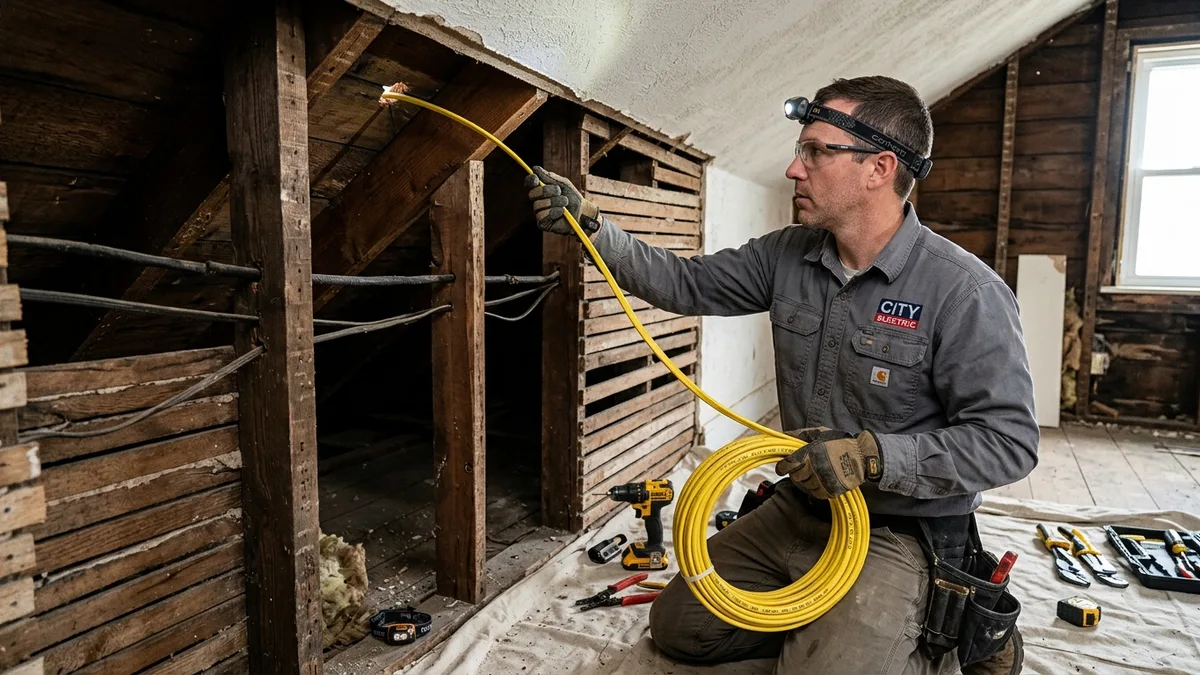
Many homeowners delay a necessary rewire because they fear their drywall or lath-and-plaster walls will be completely destroyed. Our technicians execute whole-home rewiring using precision, non-destructive wire fishing techniques:
[ Circuit Mapping and Attic/Crawl Access ] ──> [ Non-Destructive Wire Fishing ] ──> [ Junction Box Setting ] ──> [ Trim-Out and Panel Tie-In ]
- Comprehensive Electrical Mapping: We trace all existing branch circuits, identify attic and crawlspace pathways, and map out optimal vertical stud bays.
- Access from Attics and Crawlspaces: Rather than cutting large trenches across your living room walls, our technicians navigate through unfinished attics, crawlspaces, and basement ceiling joists. We drill small vertical access holes through top and bottom wall plates.
- Flexible Fish Rod and Magnetic Navigation: Utilizing flexible fiberglass fish rods, specialized long-reach flex bits, and magnetic wire retrieval systems, we pull new copper Romex cables down through finished wall cavities with minimal or zero drywall damage.
- New Steel or Fiberglass Old-Work Boxes: We replace brittle vintage metal or plastic junction boxes with sturdy, deep old-work boxes that accommodate modern AFCI, GFCI, and smart dimmer hardware without crowding conductors.
- Panel Termination and Code Certification: The new copper home runs are landed on modern Arc-Fault (AFCI) circuit breakers inside your panel, fully inspected by the City of Brighton Building Division, and certified for home insurance underwriting.
Insurance Underwriting and Real Estate Implications
If you are buying, selling, or refinancing a home in Brighton, legacy wiring can stop a transaction in its tracks:
- Homeowners Insurance Denials: Most major Colorado insurance carriers (including State Farm, Allstate, and Travelers) maintain strict underwriting guidelines that prohibit issuing or renewing policies on homes with active knob-and-tube wiring or unmitigated aluminum branch wiring.
- Four-Point Real Estate Inspections: Real estate home inspectors actively look for exposed K&T in attics and aluminum markings on Romex sheaths inside electrical panels. Unmitigated wiring frequently leads to mandatory repair escrow holdbacks or buyer financing cancellations.
- Certification Documentation: Upon completing a certified AlumiConn, COPALUM, or copper rewire, Electrician Brighton CO provides signed, official electrical contractor certification documentation that satisfies all insurance underwriters and real estate lending mandates.
For home buyers scheduling a pre-purchase review, consider pairing your inspection with our electrical safety inspection service.
Transparent Rewiring Pricing Factors
Rewiring an older home is a major infrastructure investment that permanently protects your property:
- Aluminum Wire Remediation (AlumiConn Pigtailing): Certified remediation of all outlets, wall switches, light fixtures, and junction boxes throughout an average 1,500 to 2,500 sq ft home typically ranges from $1,800 to $4,500, depending on total device counts.
- Partial Rewiring (Targeted Circuits / Finished Basements): Modernizing specific kitchen, bathroom, or garage branch circuits ranges from $800 to $2,500.
- Complete Whole-Home Copper Rewire (Drywall In-Place): A turnkey whole-home copper rewire replacing all existing knob-and-tube or aluminum wiring with new copper Romex and a new 200-amp panel typically ranges from $8,500 to $18,000 for standard single-family homes.
Estimates are for budgeting purposes only. Actual prices vary based on on-site conditions, service amperage, conduit accessibility, and municipal permit requirements.
Frequently Asked Questions About Electrical Rewiring
How do I know if my Brighton home has aluminum wiring?
Check the plastic or cloth sheath on visible electrical cables entering your main breaker box in the basement or garage. Cables manufactured with aluminum wiring during the 1960s and 1970s are stamped along their outer jacket with letters such as "ALUM", "ALUMINUM", "AL", or brand names like "Kaiser Aluminum". Additionally, open faceplates may reveal silver-colored conductors rather than the bright golden-orange of copper. Never touch exposed wiring; contact our dispatch desk for a certified inspection.
Can I just use standard purple wire nuts to fix aluminum wiring?
No. The Consumer Product Safety Commission (CPSC) and electrical engineers strongly warn against using twist-on "purple wire nuts" (such as the Ideal 65) for permanent aluminum-to-copper pigtailing. Laboratory testing has shown that twist-on wire nuts suffer high failure rates under sustained electrical loads, as the spring coil inside fails to prevent thermal creep. Only the COPALUM crimp or AlumiConn mechanical lug connectors are certified by the CPSC for safe, permanent aluminum pigtailing.
Will my walls have to be completely torn down to rewire my home?
No. Skilled residential electricians utilize specialized flexible fish rods and pull cables through attics, basements, and hollow interior stud bays. While minor drywall access cuts may be necessary in complex transitions (such as exterior insulated walls or horizontal fire-blocks), our technicians minimize wall incisions and leave clean, patchable openings.
Secure Your Vintage Brighton Home with Modern Copper Wiring Today
Protect your property from concealed electrical fire hazards and secure full insurance compliance. Connect with our Brighton rewiring specialists today.
Call (720) 677-8240 to speak directly with an experienced coordinator, or visit our contact page to request an itemized project estimate.