Quick Key Takeaways – Electrical Safety Inspection
Comprehensive Technical Audits and Real Estate Electrical Evaluations
The electrical infrastructure of a residential or commercial building is largely concealed behind drywall, attic insulation, and subterranean conduit. Because dangerous electrical faults—such as deteriorating conductor insulation, loose bus bar lugs, degraded grounding rods, and improper junction box splices—operate silently out of view, property owners often remain unaware of severe structural fire or shock hazards until equipment fails catastrophically.
In Brighton, Colorado, where homes range from hundred-year-old historic properties in Old Town to rapid new construction across Adams and Southern Weld Counties, an electrical safety inspection provides essential transparency. Whether you are purchasing a home and need a pre-closing evaluation, preparing a property for sale, experiencing mysterious electrical anomalies, or auditing an older residence for insurance compliance, an empirical electrical audit is your most powerful tool for risk mitigation.
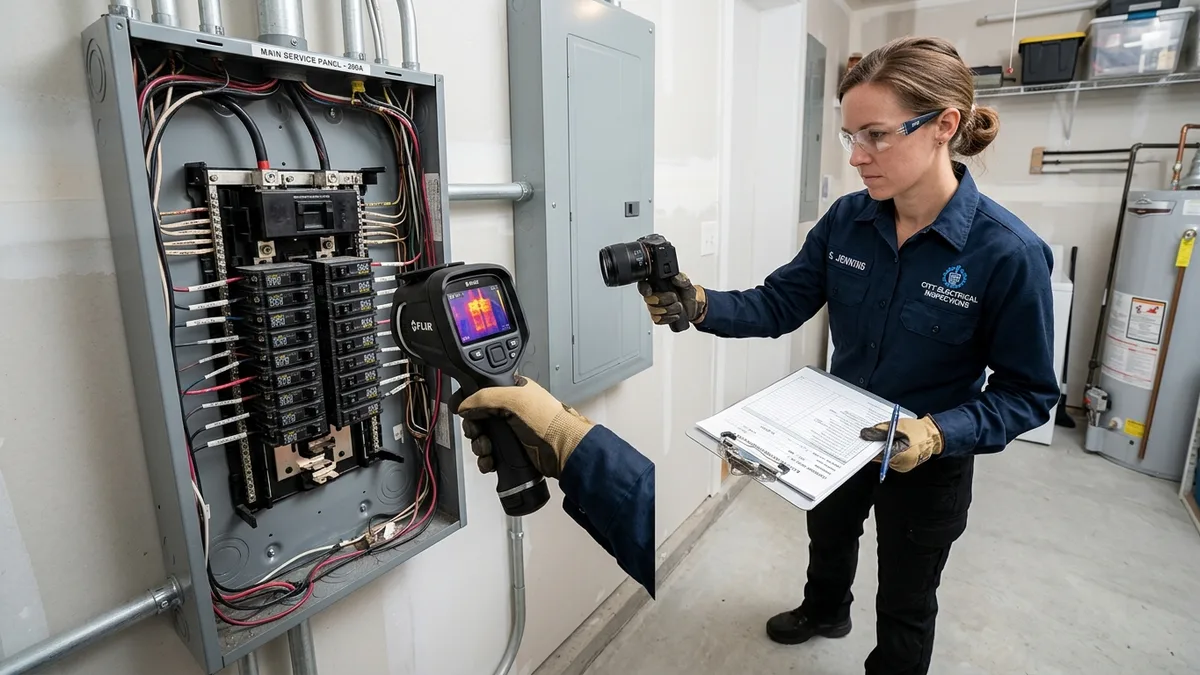
At Electrician Brighton CO, our field technicians conduct Exhaustive Electrical Safety Inspections and Code Compliance Audits. Moving far beyond the superficial visual checks typical of standard home inspectors, we utilize advanced diagnostic instrumentation—including infrared thermal imaging cameras, true-RMS clamp meters, circuit analyzers, and insulation resistance testers—to inspect every critical component of your electrical infrastructure from the utility service weatherhead to the furthest branch receptacle.
When to Schedule an Electrical Safety Inspection
While regular safety evaluations are recommended every three to five years for older properties, specific milestones demand immediate professional inspection:
1. Pre-Purchase Real Estate Due Diligence
Standard general home inspectors examine hundreds of home components in a few hours, often spending less than 15 minutes reviewing the electrical panel. They do not remove switch faceplates, test loop impedance, or perform thermal imaging scans under full electrical load. A certified electrical inspection uncovers concealed deal-breakers—such as unmitigated aluminum branch wiring, active knob-and-tube in attics, double-tapped main lugs, and undersized service panels—giving buyers leverage for repair credits or escrow holdbacks before closing.
2. Homes Reaching 25 to 30 Years of Age
Electrical panels, circuit breakers, GFCI receptacles, and wiring insulation have finite service lives. If your Brighton residence was constructed in the 1990s or earlier, branch circuits have endured decades of thermal expansion and contraction. An inspection identifies fatigue before loose connections spark an arcing fire.
3. Prior to Major Renovations or Electrification Projects
If you are planning an extensive kitchen remodel, finishing a basement living suite, adding a central air conditioning heat pump, or preparing for a Level 2 EV charger installation, an inspection determines whether your existing panel has sufficient continuous service capacity or requires an electrical panel upgrade.
4. Following a Lightning Strike or Severe High Plains Weather Event
Front Range summer convective thunderstorms produce intense cloud-to-ground lightning activity. If lightning strikes a nearby tree, utility pole, or your home's roof, transient overvoltages can damage appliance control boards, flash over inside wall switches, and melt grounding conductors. A post-storm safety inspection verifies that your electrical system has not suffered latent dielectric breakdown.
Technical Comparison: General Home Inspector vs. Certified Electrical Inspection
Understanding the difference in depth between inspection types is essential for property due diligence:
| Inspection Checkpoint | Standard General Real Estate Inspector | Certified Master Electrical Safety Inspection |
| :--- | :--- | :--- | :--- |
| Panel Dead-Front Cover | Removed for brief visual photo | Removed for comprehensive wire, lug, and breaker audit |
| Thermal Bus Bar Analysis | Rare or Superficial | Fluke Infrared Thermal Imaging under live household load |
| Branch Circuit Testing | Basic 3-light plug tester check | Digital circuit analyzer measuring voltage drop and impedance |
| GFCI / AFCI Diagnostics | Manual push-button test | Simulated millisecond trip threshold and ground fault leakage |
| Conductor Metallurgy | Noted if visible on panel jacket | Full inspection for aluminum creep or K&T attic hazards |
| Grounding Electrode Audit | Visual confirmation of ground wire | Verifies 8-ft dual ground rods, bond clamps, and water pipe bonds |
| Load Calculation | Absent (Guesses based on main breaker) | Official NEC Article 220 empirical demand load calculation |
| Repair Cost Deliverable | Vague recommendation to "consult pro" | Itemized written repair estimate with municipal permit fees |
Our Exhaustive 8-Point Electrical Inspection Checklist
When our technicians inspect your Brighton property, we execute an exhaustive, systematic audit covering all primary electrical systems:
1. Main Service Entrance and Utility Weatherhead
We inspect the incoming service conductors from United Power or Xcel Energy, verifying proper drip loops, weatherhead mast flashing, service drop clearance above driveways and grade (NEC Article 230.24), and exterior electric meter socket condition.
2. Electrical Panel, Bus Bars and Main Disconnects
We remove the panel dead-front cover to perform an exhaustive internal inspection:
- Inspecting main lugs for proper torque and thermal discoloration.
- Scanning copper bus bars with infrared thermal imaging to identify loose breaker clips, micro-arcing, and hot spots.
- Verifying circuit breaker compatibility (ensuring no unlisted "universal" or foreign breakers are installed).
- Auditing neutral and equipment grounding bus bars for prohibited "double-tapping" (multiple wires landed beneath single terminal screws).
- Inspecting for hazardous, fire-prone panel brands, including Federal Pacific Electric (FPE) Stab-Lok and Zinsco boxes.
3. Grounding Electrode System and Bonding Verification
A home's grounding system is its ultimate line of defense against lightning surges and fault currents. We verify that the main service neutral is bonded to an approved grounding electrode system, including dual 8-foot copper-clad ground rods driven into earth at least six feet apart, supplemented by bonding clamps secured to incoming metallic water service piping within five feet of entry.
4. Whole-Home Surge Protection Compliance (NEC Article 242)
We verify whether the property contains an approved Type 1 or Type 2 whole-home surge protective device (SPD) to defend appliances and electronics from grid transients, checking LED diagnostic health indicators.
5. Branch Circuit Wiring and Insulation Integrity
We inspect accessible wiring in basements, attics, and crawlspaces:
- Identifying hazardous knob-and-tube wiring that has been illegally buried beneath blown-in attic fiberglass or cellulose insulation.
- Checking for single-strand aluminum branch wiring installed during the late 1960s and early 1970s, verifying whether certified COPALUM or AlumiConn remediation has been executed.
- Inspecting for amateur, uncontained wire splices floating outside approved metal or plastic junction boxes.
6. Receptacle and Switch Safety (AFCI, GFCI and Tamper-Resistant)
Using digital circuit analyzers, we test sample outlets across every room:
- Verifying proper hot-neutral-ground polarity.
- Testing Ground-Fault Circuit-Interrupters (GFCI) in kitchens, bathrooms, garages, and outdoor locations to verify trip response times under 25 milliseconds.
- Checking living area branch circuits for code-mandated Arc-Fault Circuit-Interrupters (AFCI).
- Verifying child-safe Tamper-Resistant (TR) shutters on all standard outlets and switches.
7. Fixed Appliance and Dedicated Circuit Integrity
We inspect dedicated 240-volt branch circuits supplying central air conditioning condensers, electric furnaces, heat pumps, water heaters, and clothes dryers, checking wire gauge sizing, disconnect switch accessibility, and fuse/breaker overcurrent ratings.
8. Life-Safety Detector Audit (Colorado State Mandates)
We inspect all smoke alarms and carbon monoxide detectors, verifying code compliance under Colorado's Lofgren and Dixon Life Safety laws, ensuring alarms are located inside every sleeping room, immediately outside sleeping corridors, and on every habitable floor level.
Deliverables: The Comprehensive Electrical Inspection Report
Following the on-site evaluation, you receive an official, written Comprehensive Electrical Safety Audit Report:
[ On-Site Diagnostic Audit ] ──> [ Thermal Photo Documentation ] ──> [ Severity Categorization ] ──> [ Itemized Repair Estimates ]
- Photographic Evidence: High-resolution digital photographs and thermal imaging captures documenting every identified defect, loose connection, or code non-compliance.
- Three-Tier Severity Categorization:
- Immediate Safety Hazards: High-risk defects requiring prompt remediation (such as active arcing, burned bus bars, missing grounds on major appliances, or unmitigated aluminum wire connections).
- Code Non-Compliance: Departures from the 2023 National Electrical Code (such as missing GFCI/AFCI protection, improper box fill, or lack of exterior emergency disconnects).
- Advisory Upgrades: Recommended modernizations that enhance convenience, capacity, or energy efficiency (such as adding surge protection or upgrading to a 200-amp panel).
- Official Contractor Repair Estimate: An itemized, written estimate detailing the exact costs to remediate all identified defects, complete with municipal permit fees and code citations, providing powerful documentation for real estate negotiations.
To review our company trade standards and clean-tech customer protections, visit our About Us page.
Transparent Inspection Pricing Factors
An electrical safety inspection is an affordable investment that prevents catastrophic expenses:
- Standard Single-Family Residential Inspection (Up to 2,500 Sq Ft): Comprehensive on-site audit of the main panel, service entrance, branch circuits, life-safety alarms, and grounding system, complete with written report, typically ranges from $250 to $450.
- Large Custom Home or Rural Estate Inspection (2,500+ Sq Ft / Outbuildings): Properties featuring subpanels, acreage well pumps, and standby generator systems range from $400 to $700.
- Targeted Diagnostic Inspection (Specific Issue / Single Panel): Auditing a specific concern (such as evaluating an older panel or investigating recurring breaker trips) ranges from $180 to $300.
- Credit Toward Subsequent Repairs: If our inspection identifies defects that you choose to hire our team to remediate, a portion of the inspection investment is frequently credited toward your authorized repair scope.
Estimates are for budgeting purposes only. Actual prices vary based on on-site conditions, service amperage, conduit accessibility, and municipal permit requirements.
Frequently Asked Questions About Electrical Safety Inspections
Will I receive a written report I can share with my real estate agent and lender?
Yes. We deliver a comprehensive, professionally formatted digital PDF report complete with high-resolution photographs, infrared thermal imaging scans, code citations, and itemized repair estimates that can be shared directly with real estate agents, home sellers, insurance underwriters, and mortgage underwriters.
How long does an electrical safety inspection take on site?
For an average single-family home in Brighton, our technicians spend between 1.5 and 2.5 hours on site conducting physical panel inspections, thermal imaging scans, and branch circuit testing. Larger homes with detached workshops or semi-rural properties in Todd Creek may take 3 to 4 hours.
Can an electrical inspection fail?
A professional safety inspection is not a pass/fail municipal examination; it is an objective technical assessment of your system's current physical condition, safety risks, and alignment with national electrical codes. We provide you with the unbiased technical data required to make informed decisions regarding safety, property negotiations, and necessary modernizations.
Schedule Your Brighton Electrical Safety Inspection Today
Gain complete clarity regarding your home's electrical safety and compliance. Connect with our Brighton field dispatch desk today.
Call (720) 677-8240 to speak directly with an inspection coordinator, or visit our contact page to request an appointment.