Quick Key Takeaways – Outlet and Switch Installation
Precision Receptacle and Switch Services for Brighton Properties
Electrical outlets (receptacles) and wall switches are the most frequently used electrical components in your home. Every time you plug in a smartphone charger, brew morning coffee, run a high-draw microwave, or flip on a room light, you rely on the mechanical and electrical integrity of these small wall-mounted devices.
Yet, because outlets and switches are so ubiquitous, property owners in Brighton, Colorado often overlook their gradual degradation. Over decades of constant friction, insertion, and thermal expansion, internal spring contacts inside wall receptacles lose their clamping tension. Loose internal contacts create high electrical resistance, generating localized heat that melts plastic faceplates and sparks concealed electrical fires inside wall cavities.
Furthermore, older homes constructed throughout Historic Downtown Brighton and early Adams County agricultural homesteads frequently feature obsolete two-prong ungrounded outlets, ungrounded switch boxes, or hazardous "back-stabbed" push-in wire connections that violate modern safety codes.
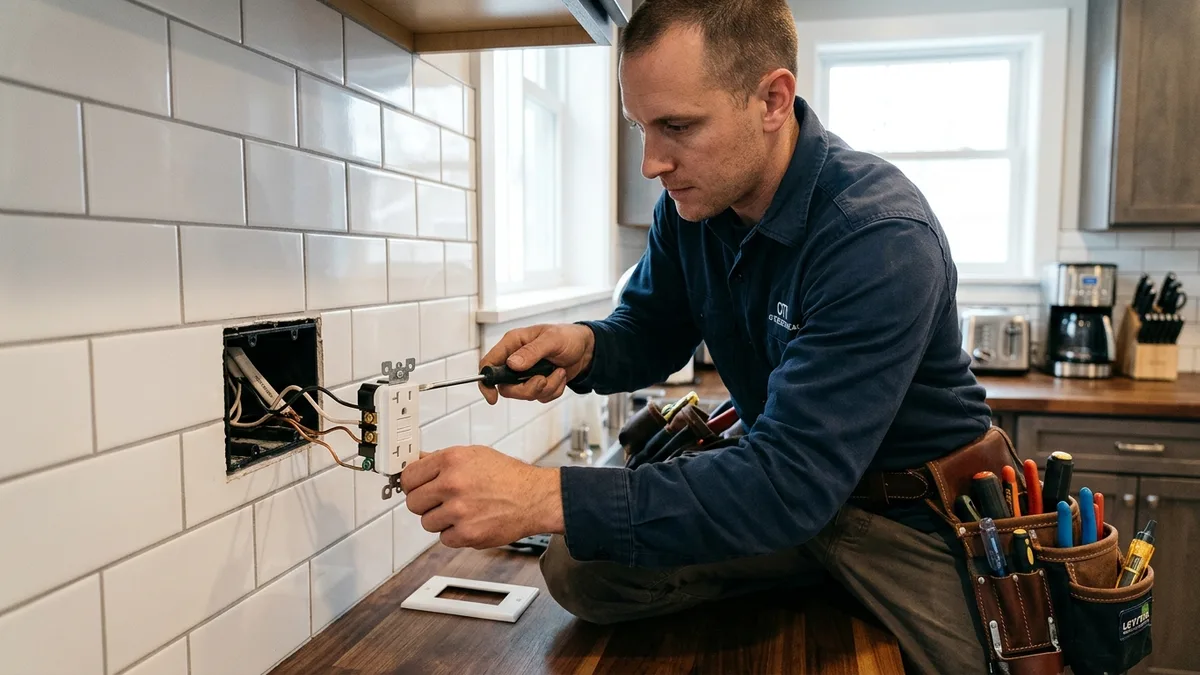
At Electrician Brighton CO, our field technicians provide complete Outlet and Switch Installation, Repair, and Upgrades. From installing code-mandated Ground-Fault Circuit-Interrupters (GFCI) and child-safe Tamper-Resistant (TR) receptacles to running high-capacity 240-volt dedicated circuits for garage workshops and installing smart lighting controls, we deliver code-compliant craftsmanship backed by transparent written estimates.
Technical Comparison: Modern Receptacle Types and Code Mandates
Modern electrical codes have evolved significantly to protect families from accidental electrocution, electrical arcing, and equipment damage. Review the technical differences between modern receptacle types:
| Receptacle Classification | Primary Safety Mechanism | Engineered Purpose | 2023 NEC Mandated Locations |
|---|---|---|---|
| Tamper-Resistant (TR) | Internal spring-loaded sliding shutters | Blocks foreign objects (keys, paperclips) inserted by children | Mandatory across ALL residential living spaces (NEC 406.12) |
| GFCI Receptacle | Differential transformer sensing 4-6mA current leak | Trips in 25 milliseconds to prevent fatal electrical shocks | Kitchens, baths, basements, outdoors, garages (NEC 210.8) |
| AFCI Receptacle | Digital microprocessor detecting electrical arcing | Prevents electrical fires from damaged or frayed wiring | Branch circuit living spaces where panel AFCI is unavailable |
| USB-A / USB-C Receptacle | Integrated step-down transformer and DC ports | High-speed smartphone/tablet charging without bulky adapters | Kitchen islands, nightstands, living rooms, home offices |
| Commercial-Grade Spec | Heavy-duty brass strap and reinforced nylon face | Heavy continuous plug retention; resists mechanical cracking | Garages, workshops, laundry rooms, continuous-duty tools |
| Dedicated 240V Receptacle | NEMA 6-20, 6-50, 10-30, or 14-50 configurations | Powers heavy continuous loads without tripping branch circuits | Hot tubs, welders, air compressors, EV chargers |
The Hidden Danger of Back-Stabbed Push-In Connections
In thousands of homes constructed across Brighton between 1970 and 2005, electrical contractors utilized a rapid-installation method known as "back-stabbing" to speed up construction. Most builder-grade 15-amp receptacles feature small spring-clamp holes on the rear casing where stripped copper wires can simply be pushed into place without tightening side screw terminals.
Why Back-Stabbing Creates Severe Fire Hazards:
- Minimal Contact Surface Area: A back-stabbed connection relies on a tiny, razor-thin brass spring leaf biting into the copper wire. The actual physical contact area is a fraction of a millimeter.
- Thermal Fatigue and Creep: As current flows through the circuit, the wire naturally warms and expands; when the appliance turns off, it cools and contracts. Over thousands of heating and cooling cycles, the spring tension degrades, allowing the copper wire to loosen inside the hole.
- High-Resistance Micro-Arcing: When a high-draw appliance (such as a 1,500-watt space heater, iron, or hair dryer) is operated on a loose back-stabbed receptacle, current arcs across the micro-gap. The connection can reach temperatures exceeding 400 degrees Fahrenheit, melting the receptacle body, scorching the drywall, and triggering electrical fires.
Our Standard: Electrician Brighton CO strictly prohibits back-stabbing. When installing or replacing outlets, our technicians exclusively utilize commercial-grade screw-terminal bindings or screw-actuated clamp plates, torqued to manufacturer specifications to guarantee permanent mechanical contact.
Solutions for Legacy Two-Prong Ungrounded Outlets
Many vintage residences in Brighton still feature original two-prong outlets lacking an equipment grounding conductor. Homeowners often wonder how to safely modernize these receptacles without incurring the massive expense of opening every wall to pull new grounded Romex cable.
2023 NEC Code-Compliant Retrofit Options (NEC Article 406.4(D)(2)):
- Option 1: Installing a GFCI Receptacle on an Ungrounded Circuit: The National Electrical Code explicitly permits replacing a two-prong ungrounded outlet with a modern three-prong GFCI receptacle, provided it is permanently labeled with the official sticker:
"No Equipment Ground". Because a GFCI monitors the differential balance between hot and neutral currents rather than relying on a ground wire, it will still trip within milliseconds if current leaks through a person's body, providing 100% personnel shock protection. - Option 2: Feeding Downstream Standard Outlets from a GFCI: A single GFCI receptacle installed at the beginning of an ungrounded branch circuit can protect multiple standard three-prong outlets connected to its "LOAD" terminals, provided all downstream receptacles are labeled
"GFCI Protected, No Equipment Ground". - Important Electronic Limitation: While GFCI protection prevents human electrocution on ungrounded circuits, it does not provide an electrical path to ground for electronic surge dissipation. Sensitive computers, gaming consoles, and audio equipment requiring an equipment ground should be supplied by newly pulled grounded branch circuits.
Dedicated 240-Volt Circuits for High-Draw Equipment
Standard 120-volt 15-amp and 20-amp household circuits are designed for light lighting and portable appliances. High-demand equipment requires dedicated individual branch circuits engineered with heavy-gauge conductors and dedicated double-pole circuit breaker replacements:
- Garage Workshops and Machine Shops: Table saws, jointers, multi-stage air compressors, and MIG/TIG welders requiring NEMA 6-20 (20A 240V) or NEMA 6-50 (50A 240V) outlets.
- Hot Tubs and Swim Spas: Exterior spa installations requiring 50-amp or 60-amp 240-volt dedicated subpanel feeds with manual emergency shutoff disconnects located within sight of the water but at least five feet away under NEC Article 680.
- Kitchen and Laundry Modernization: Running dedicated circuits for electric ranges, induction cooktops, clothes dryers, and built-in microwave/convection ovens.
- Basement Finishes: Roughing in dedicated circuits for home theaters, wet bar mini-refrigerators, and electric baseboard heating.
Smart Lighting Switches and Automation Controls
Modernizing your wall switches enhances energy efficiency, convenience, and home security. Our technicians install:
- Smart Wi-Fi and Zigbee/Z-Wave Switches: Brands like Lutron Caseta, Leviton, and TP-Link Kasa that allow homeowners to schedule lighting, create automated scenes, and control fixtures remotely via smartphone or voice assistants.
- Multi-Location 3-Way and 4-Way Switching: Resolving confusing stairwell and hallway switching, ensuring lights can be operated seamlessly from multiple wall locations.
- Occupancy and Motion Sensors: Automated sensor switches in laundry rooms, pantries, and garages that turn lights on upon entry and shut off automatically after vacancies.
- Smart LED Dimmers: Digital dimmers engineered to eliminate the high-frequency buzzing, strobing, and flickering common when standard dimmers are paired with modern LED fixtures. For custom architectural illumination, pair your controls with our lighting installation services.
Transparent Outlet and Switch Pricing Factors
Receptacle and switch replacements are among the most accessible and high-impact electrical improvements for your home:
- Standard Receptacle / Switch Replacement: Replacing existing builder-grade outlets or switches with commercial-grade tamper-resistant hardware typically ranges from $120 to $250 for an initial service visit, with deeply discounted per-unit pricing for whole-home changeouts.
- GFCI Receptacle Installation / Retrofit: Installing modern self-testing GFCI receptacles with weather-resistant or tamper-resistant ratings ranges from $150 to $280 per location.
- Smart Dimmer / Timer Switch Installation: Replacing standard switches with customer-supplied or technician-provided smart Wi-Fi dimmers ranges from $140 to $260.
- New Dedicated 240-Volt Circuit Run: Running a dedicated 30A to 50A circuit from an existing panel to a garage or outdoor hot tub generally ranges from $450 to $1,200, depending on conduit distance and basement ceiling access. If your main panel lacks open breaker spaces, consult our electrical panel upgrade services.
Estimates are for budgeting purposes only. Actual prices vary based on on-site conditions, service amperage, conduit accessibility, and municipal permit requirements.
Frequently Asked Questions About Outlets and Switches
Why do plugs fall out or feel loose when plugged into my wall outlets?
When plugs slip out of an outlet or sag downward, the internal phosphor-bronze spring contact blades inside the receptacle have stretched out and lost their mechanical tension. This is a severe fire hazard; loose contact blades create high-resistance micro-gaps that generate intense heat and sparking. Receptacles with loose tension should be replaced promptly.
What is the "TEST" and "RESET" button on my GFCI outlet?
GFCI receptacles feature internal electronic sensors that monitor current balance. The "TEST" button simulates a 4 to 6 milliamp ground fault, causing the internal contacts to open and the "RESET" button to pop out, cutting power. Modern 2023 NEC compliant GFCIs feature an automated self-testing function; if the internal sensor ever fails, an LED status light illuminates red or the outlet locks itself out permanently, preventing ungrounded power from being delivered.
Can an outlet switch fire occur without tripping the circuit breaker?
Yes. Standard thermal-magnetic circuit breakers only trip when current exceeds 15 or 20 amps. A loose back-stabbed connection or arcing switch terminal can generate extreme heat (exceeding 500 degrees Fahrenheit) at just 5 to 10 amps of current—well below the threshold required to trip the breaker. This is why modern Arc-Fault Circuit-Interrupters (AFCI) and quality screw-terminal installation are vital safety defenses.
Upgrade Your Brighton Home's Outlets and Switches Today
Eliminate loose receptacles, flickering dimmer switches, and ungrounded electrical hazards. Connect with our local field dispatch desk today.
Call (720) 677-8240 to speak directly with an experienced field coordinator, or visit our contact page to request an itemized project estimate.