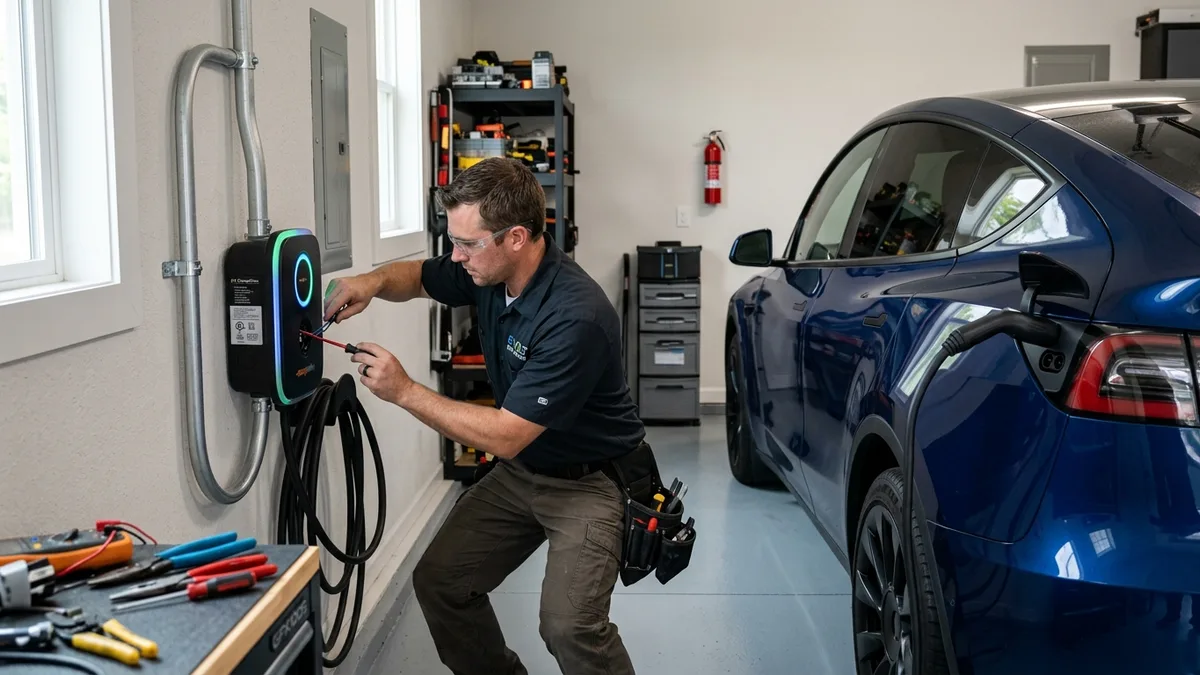
Quick Key Takeaways – EV Charger Installation
High-Speed Residential and Commercial EV Charging Solutions in Brighton
Transitioning to an electric vehicle—whether a Tesla Model Y, Ford F-150 Lightning, Rivian R1T, Hyundai Ioniq 5, or Chevrolet Silverado EV—is an exciting step toward lower fuel costs, reduced maintenance, and instant performance across the Front Range. However, the charging experience of owning an electric vehicle depends almost entirely on the speed and reliability of your residential charging setup.
Most electric vehicles come with a basic Level 1 portable emergency cord that plugs into a standard 120-volt three-prong wall outlet. In practical use, Level 1 charging delivers a meager 1.2 to 1.4 kilowatts of electrical power, trickling approximately 3 to 5 miles of driving range per hour of charging. For a daily commuter traveling along Interstate 76, E-470, or Highway 85 between Brighton and Denver, recovering 50 to 80 miles of daily highway commute on a standard outlet can require 16 to 24 continuous hours of charging.
At Electrician Brighton CO, our field technicians specialize in professional Level 2 Electric Vehicle Charging Station Installations. By engineering a dedicated 240-volt, 40-amp to 60-amp branch circuit directly from your main electrical panel to your garage, carport, or outdoor parking pad, we deliver 7.7 to 11.5 kilowatts of charging power. This increases charging speeds to 30 to 44 miles of range per hour, ensuring your vehicle charges completely from empty to 100% overnight while you sleep.
We handle complete turnkey installations throughout Brighton, Adams County, and Southern Weld County, including load capacity calculations, municipal permits through the City of Brighton Community Development Department, and utility rebate coordination with United Power and Xcel Energy.
Technical Comparison: Level 1 vs. Level 2 (NEMA 14-50) vs. Level 2 (Hardwired)
Understanding the technical differences between charging configurations is essential for optimizing charging speed and long-term hardware reliability:
| Specification Parameter | Level 1 Portable Cord | Level 2 NEMA 14-50 Plug-In | Level 2 Dedicated Hardwired Unit |
|---|---|---|---|
| Voltage and Phase | 120 Volts (Single Phase) | 240 Volts (Single Phase) | 240 Volts (Single Phase) |
| Dedicated Breaker Rating | Shared 15A or 20A Breaker | Dedicated 40A or 50A Breaker | Dedicated 50A or 60A Breaker |
| Continuous Operating Current | 12 Amps (80% Rule) | 32 Amps to 40 Amps | 40 Amps to 48 Amps |
| Power Output (kW) | ~1.4 kW | 7.6 kW to 9.6 kW | 9.6 kW to 11.5 kW |
| Miles of Range Per Hour | 3 to 5 Miles / Hour | 25 to 35 Miles / Hour | 35 to 44 Miles / Hour |
| Full Battery Recharge Time | 24 to 36+ Hours | 7 to 9 Hours | 5 to 7 Hours |
| NEC 2023 GFCI Requirement | Required on Receptacle | Mandatory GFCI Breaker (NEC 210.8) | Internal Unit GFCI (Standard Breaker) |
| Durability and Thermal Stress | Light Duty | Moderate (Plug Wear and Tear) | Maximum (Permanent Direct Lugs) |
Hardwired Wall Chargers vs. NEMA 14-50 Plug-In Receptacles
When designing a Level 2 charging setup, homeowners in Brighton must decide between installing an industrial-grade NEMA 14-50 receptacle or hardwiring a permanent wall charging station. While both approaches provide high-speed 240-volt charging, there are vital engineering distinctions:
The Hardwired Advantage (Recommended for Maximum Performance):
- Maximum 48-Amp Charging Speeds: Under National Electrical Code Article 625, a plug-in EV charger using a NEMA 14-50 receptacle is limited to a maximum continuous draw of 40 amps (on a 50-amp breaker) or 32 amps (on a 40-amp breaker). A hardwired charging station—such as a Tesla Wall Connector or ChargePoint Home Flex—can be installed on a 60-amp breaker, delivering a full 48 amps of continuous charging power (11.5 kW), which charges larger truck and SUV batteries up to 25% faster.
- Eliminates Nuisance GFCI Tripping: The 2023 National Electrical Code (NEC Article 210.8) mandates that all 240-volt receptacles installed in residential garages must be protected by a GFCI circuit breaker in the main panel. However, virtually all modern EV charging stations already contain sensitive built-in GFCI microprocessors. When an EV charger with internal GFCI is plugged into a circuit protected by a panel GFCI breaker, the two monitoring systems can interfere with one another, causing random nuisance trips during charging cycles. Hardwiring the charger bypasses this issue entirely, as the hardwired connection does not require an upstream GFCI breaker.
- Superior Thermal and Weather Durability: Electric vehicle charging represents a heavy continuous electrical load that operates at high amperage for 4 to 8 hours uninterrupted. Inexpensive builder-grade 50-amp range receptacles are not engineered for repeated high-cycle continuous thermal stress and can degrade or melt. Hardwiring utilizes heavy copper conductors secured directly to torque-calibrated lugs, eliminating mechanical plug resistance.
Evaluating Your Electrical Panel Capacity
Before installing a 240-volt Level 2 charging circuit, a certified technician must evaluate whether your home's main electrical service has sufficient capacity to support the additional load:
When a Panel Has Ample Capacity:
If your home in an established neighborhood like Bromley Park or Brighton East Farms features a modern 200-amp service panel with available physical breaker slots, our technicians can typically install a 50-amp or 60-amp double-pole breaker directly. We calculate existing household continuous demand under NEC Article 220, pull heavy 6 AWG copper conductor through protective EMT conduit, and complete the installation smoothly.
When an Electrical Service Heavy-Up Is Required:
If your home is located near Historic Downtown Brighton or was constructed prior to 1995 with a 100-amp or 125-amp service panel that already powers an electric range, clothes dryer, and central air conditioner, adding a 40-amp continuous EV load will exceed the main service limit. In these circumstances, operating the charger while running household appliances can cause the main service breaker to overheat and trip. Homeowners face two options:
- Executing an Electrical Panel Upgrade: Transitioning the service from 100 amps to 200 amps with a new outdoor meter-main enclosure, whole-home surge suppression, and utility coordination through United Power or Xcel Energy. Explore our electrical panel upgrade services.
- Installing an Intelligent Energy Management Device (Load Shedder): If a full service upgrade is not immediately feasible, our team can install a UL-listed smart energy monitor (such as a DCC-9 or Wallbox Pulsar with Power Meter). This device continuously monitors total household electrical draw; if total demand approaches 80% of panel capacity, the device automatically pauses or throttles EV charging until household appliance demand subsides.
Equipment Compatibility Across Leading EV Charger Brands
Our technicians install and commission all major commercial-grade Level 2 charging stations:
- Tesla Universal Wall Connector: Features an integrated Magic Dock adapter supporting both native Tesla North American Charging Standard (NACS) vehicles and standard J1772 electric vehicles without external dongles. Delivers up to 48 amps (11.5 kW).
- ChargePoint Home Flex: Highly rated smart charger capable of hardwired speeds up to 50 amps. Features built-in Wi-Fi, smartphone scheduling, and energy tracking integration.
- Emporia EV Charger: Cost-effective, high-performance charging unit supporting up to 48 amps hardwired, paired with comprehensive real-time home energy monitoring.
- JuiceBox 40 / 48: Robust commercial-grade residential charging stations engineered for indoor garage or outdoor weatherproof pedestal installation.
Utility Rebates and Off-Peak Charging Incentives in Brighton
Installing a Level 2 electric vehicle charger in Brighton qualifies homeowners for significant financial incentives from regional utilities:
- Xcel Energy EV Charging Rebates: In Xcel Energy territory, homeowners enrolling in qualifying off-peak EV charging programs can receive rebates of up to $500 toward charging equipment and installation costs, alongside deeply discounted off-peak electric rates for charging overnight between 9:00 PM and 9:00 AM.
- United Power Electric Vehicle Programs: Headquartered right in Brighton at 500 Cooperative Way, United Power offers specialized EV rate structures and cooperative incentives for members installing smart Level 2 chargers that participate in grid-balancing demand response initiatives.
Our dispatch team assists you with all required documentation, equipment spec sheets, and municipal permit copies to ensure you maximize available utility rebates.
Turnkey Installation Workflow
We execute your EV charging installation through a streamlined, professional process:
[ Site Assessment and Load Calculation ] ──> [ City Permit ] ──> [ Conduit and Wiring Installation ] ──> [ Station Commissioning ]
- Site Assessment and Panel Calculation: Our technician evaluates your main panel, measures conduit distances to your preferred parking spot, and performs an official NEC load calculation.
- Municipal Permitting: We file the electrical branch circuit permit through the City of Brighton Community Development Department or Adams County CEDD.
- Precision Installation: We install a heavy-duty double-pole circuit breaker, run commercial-grade steel EMT conduit or Romex cable, set the charging station at an ergonomic height, and torque all electrical terminals with calibrated screwdrivers.
- Commissioning and Testing: We configure the charger's internal DIP switches or smartphone software, verify ground continuity, test voltage under simulated charging load, and walk you through connecting your vehicle for the first time.
For an extensive pricing breakdown covering equipment choices, conduit run lengths, and utility rebate impacts, consult our comprehensive EV charger installation cost guide.
Estimates are for budgeting purposes only. Actual prices vary based on on-site conditions, service amperage, conduit accessibility, and municipal permit requirements.
Frequently Asked Questions About EV Charger Installation
Can I install an EV charger outdoors if I do not have a garage?
Yes. All major Level 2 chargers (including the Tesla Wall Connector and ChargePoint Home Flex) feature NEMA 3R or NEMA 4 weatherproof enclosures engineered to withstand severe Colorado high plains winters, freezing rain, blowing dust, and summer sun. Our technicians install outdoor chargers directly onto exterior building siding or on a dedicated steel pedestal adjacent to your driveway.
How much does it cost to install a Level 2 EV charger in Brighton?
If your electrical panel is located in the garage with available breaker capacity, a standard installation typically ranges from $750 to $1,500, plus the cost of the charging station itself. If the electrical panel is on the opposite side of the home in a finished basement, requiring a long conduit run across the property, costs adjust accordingly. Review our EV charger cost guide for line-item details.
Will charging an EV cause my home's circuit breakers to trip?
Not when properly engineered. Under the National Electrical Code, an EV charger operates on a dedicated branch circuit with no other receptacles or appliances sharing the line. Our technicians calculate your main service demand prior to installation, ensuring that charging your car will never cause household breakers to trip.
Schedule Your Level 2 EV Charger Installation Today
Take full advantage of electric vehicle ownership with fast, convenient, overnight home charging. Connect with our local Brighton field dispatch team today.
Call (720) 677-8240 to speak directly with an experienced coordinator, or visit our contact page to request an itemized project estimate.