Quick Key Takeaways – Circuit Breaker Repair
Precision Circuit Breaker Diagnostics and Replacement Across Brighton
A circuit breaker is one of the most critical automated safety devices in your home. Engineered as a calibrated thermal and magnetic switch, each breaker inside your main electrical service panel is designed to monitor the continuous flow of electrical current through a dedicated branch circuit. When the current exceeds the safe ampacity of the circuit wiring—or when an active electrical short occurs—the breaker's internal bi-metallic strip or magnetic solenoid physically trips, opening the circuit in a fraction of a second and stopping the flow of electrical power before wires can melt or spark a structural fire.
However, when a circuit breaker repeatedly trips, feels hot to the touch, produces a persistent buzzing sound, or refuses to reset, homeowners in Brighton, Colorado face an immediate diagnostic question: Is the breaker itself defective, or is it performing its engineered safety duty by alerting you to a dangerous electrical condition inside your walls?
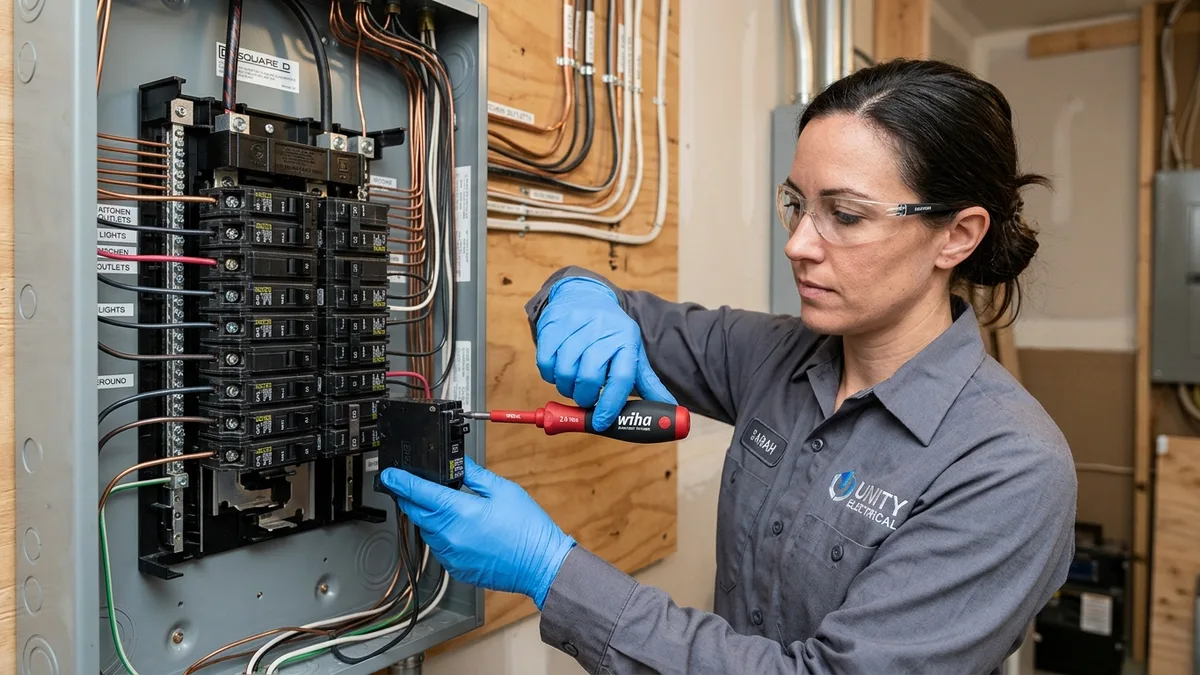
At Electrician Brighton CO, our field technicians provide empirical circuit breaker diagnostics and replacement across all established subdivisions and semi-rural properties in Brighton, Adams County, and Southern Weld County. Using digital multimeters, true-RMS clamp meters, and insulation resistance analyzers, we pinpoint the exact mechanical or electrical root cause and restore safe, code-compliant power to your property.
The Three Primary Causes of Circuit Breaker Tripping
Circuit breakers do not trip randomly. Under the National Electrical Code, a breaker trips due to three distinct electrical failure modes. Distinguishing between these failure modes is the foundation of professional troubleshooting:
1. Thermal Overload (Drawing More Amperage Than Rated)
The most common cause of circuit breaker tripping is an electrical overload. Every residential branch circuit is rated for a specific continuous amperage—typically 15 amps (wired with 14 AWG copper conductor) or 20 amps (wired with 12 AWG copper conductor). Under the 80% continuous load safety rule mandated by the NEC, a 15-amp circuit should not carry more than 12 amps (1,440 watts) continuously, and a 20-amp circuit should not carry more than 16 amps (1,920 watts).
- Typical Scenario: Operating a 1,500-watt portable space heater while running an 800-watt vacuum cleaner or a high-draw gaming computer on the same bedroom circuit will draw approximately 19 to 20 amps on a 15-amp circuit. Over a span of several minutes, the breaker's internal bi-metallic strip heats up, bends, and mechanically trips the breaker handle into the center position.
2. Direct Short Circuit (Hot Wire Touching Neutral)
A short circuit is a far more dangerous event. It occurs when an energized "hot" black or red conductor directly contacts a neutral white conductor, an equipment grounding conductor, or a grounded metal junction box. Because there is virtually zero electrical resistance in a direct short, Ohm's Law dictates that current surges instantly to hundreds or thousands of amps.
- Typical Scenario: A nail driven through a wall stud pierces non-metallic Romex cable, an extension cord is crushed under heavy furniture, or water enters an outdoor receptacle. When a short occurs, the breaker trips instantly with an audible pop or snap. If you reset a breaker on an active short circuit, it will trip immediately and violently.
3. Ground Fault (Current Leaking Outside the Circuit Path)
A ground fault occurs when an energized hot conductor comes into direct contact with a grounded surface, such as the bare copper ground wire, a metal outlet box, or the metallic chassis of an appliance. Ground faults frequently occur in areas exposed to moisture—including kitchens, bathrooms, garages, unfinished basements, and outdoor patios. In the presence of water, current leaks along an unintentional path, posing severe electrical shock hazards to anyone touching the appliance.
Technical Comparison: Breaker Types and Protection Levels
Modern electrical panels feature specialized breaker typologies engineered to detect specific hazard profiles:
| Circuit Breaker Type | Primary Hazard Defended Against | Internal Trip Mechanism | 2023 NEC Mandated Locations |
|---|---|---|---|
| Standard Thermal-Magnetic | Thermal Overloads and Direct Short Circuits | Bi-metallic thermal strip + Magnetic solenoid | Legacy standard; general utility circuits |
| GFCI Circuit Breaker | Personnel Electrical Shock and Current Leakage | Differential transformer sensing 4-6mA imbalance | Kitchens, baths, basements, outdoors (NEC 210.8) |
| AFCI Circuit Breaker | Arcing Electrical Fires from Damaged Wiring | Advanced microprocessor analyzing wave anomalies | Bedrooms, living rooms, hallways (NEC 210.12) |
| Dual-Function AFCI/GFCI | Complete Arcing Fire and Fatal Shock Protection | Combined digital signal processor + differential coil | Kitchens, laundry rooms, wet/finished basements |
The Severe Danger of Repeatedly Resetting a Tripping Breaker
A common and dangerous mistake made by homeowners is repeatedly forcing a tripping circuit breaker back to the "ON" position without investigating the underlying cause. Some individuals even attempt to tape or wedge the breaker handle open.
Why You Must Never Force a Circuit Breaker Closed:
- Breakers Are "Trip-Free" Mechanisms: Commercial-grade circuit breakers manufactured by Square D, Siemens, and Eaton are engineered with an internal "trip-free" mechanical linkage. Even if the external plastic handle is taped or held forcibly in the "ON" position, the internal contacts will still open if a short circuit or thermal overload is present.
- Thermal Fatigue and Contact Welding: Repeatedly resetting a breaker on an active short circuit subjects the internal silver-alloy contact points to extreme electrical arcing. Over multiple resets, the intense heat can weld the contacts together, rendering the breaker completely incapable of opening. When this happens, the electrical current continues to flow uncontrolled, heating the in-wall branch wiring until it ignites structural framing.
- Internal Wire Damage: Branch circuit wiring within your walls is insulated with thermoplastic materials rated for a maximum temperature of 90 degrees Celsius (194 degrees Fahrenheit). Subjecting wiring to continuous overload current melts the insulation, creating concealed fire hazards behind your drywall.
If a breaker trips once, it is acceptable to switch it firmly to the "OFF" position and back to "ON" one time. If it trips immediately or repeatedly within a few hours, stop resetting it and contact our dispatch desk for emergency electrical repair.
Professional Empirical Diagnostic Workflow
When an Electrician Brighton CO technician arrives at your home, we execute a comprehensive 5-step diagnostic procedure:
[ Circuit Load Analysis ] ──> [ Thermal Imaging Scan ] ──> [ Insulation Resistance Testing ] ──> [ OEM Breaker Replacement ] ──> [ Load Balancing ]
- Digital Amperage Load Measurement: We clamp a true-RMS multimeter onto the branch circuit conductor at the panel while household appliances are operated, measuring the exact continuous amperage draw.
- Thermal Imaging Bus Bar Scan: Using Fluke infrared thermal cameras, we inspect the breaker's connection to the main copper bus bar. High resistance caused by loose clips or oxidation produces a distinct thermal hot spot that can be resolved before bus bar damage occurs.
- Insulation Resistance Megger Testing: If a short circuit or ground fault is suspected inside a wall, we disconnect the branch circuit and apply a 500-volt DC test current using a megohmmeter to verify that the conductor's dielectric insulation has not broken down.
- OEM Breaker Replacement: If testing confirms that internal thermal-magnetic fatigue has degraded the breaker mechanism, we replace the unit with an exact OEM breaker matched to your panel's UL listing (such as Square D QO/Homeline, Siemens QP, or Eaton BR/CH). We never install unlisted "universal" or counterfeit breakers that violate manufacturer warranties.
- Panel Phase Load Balancing: If an entire phase of your panel is running significantly hotter than the opposing phase, we reorganize branch circuits across phases A and B to balance household electrical demand evenly across the utility service feed.
When Breaker Repair Indicates a Larger Panel Problem
While replacing an individual worn breaker is a routine, cost-effective repair, recurring breaker issues across multiple circuits often indicate systemic electrical panel failure:
- Panel Capacity Is Maxed Out: If your main panel is rated at 100 amps and contains zero open expansion slots, adding modern electrical appliances requires transitioning to a full 200-amp electrical panel upgrade.
- Obsolete Panel Hazards: If your home features a Federal Pacific Electric (FPE) Stab-Lok panel or a Zinsco breaker box, individual breaker replacement is strongly discouraged by fire safety agencies, as the panel bus bars themselves are fundamentally defective and present active fire hazards.
- Micro-Arcing and Pitted Bus Bars: If thermal imaging reveals that loose breaker clips have burned and pitted the panel's interior copper bus bar, clipping a new breaker onto the damaged metal will result in renewed arcing. In such cases, replacing the interior panel guts or upgrading the entire load center is the only safe, code-compliant remedy.
For properties experiencing widespread outlet or switch malfunctions alongside breaker tripping, review our outlet and switch installation services, or consult our detailed diagnostic guide on why circuit breakers keep tripping.
Transparent Circuit Breaker Pricing Factors
Circuit breaker replacement is a fast, precise service when performed by experienced technicians. Typical investment parameters across Brighton, Adams County, and Weld County include:
- Single Standard 15A/20A Breaker Replacement: Replacing a fatigued single-pole standard thermal-magnetic breaker typically ranges from $150 to $300, including diagnostic testing, OEM parts, and bus bar terminal inspection.
- Dual-Pole 240V Breaker Replacement: Replacing a 30-amp to 60-amp dual-pole breaker for an electric range, clothes dryer, or air conditioning condenser generally ranges from $220 to $450.
- Electronic AFCI, GFCI, or Dual-Function Breaker: Replacing modern electronic breakers containing internal microprocessors ranges from $250 to $480 due to higher component manufacturing costs.
- Panel Phase Rebalancing: Rearranging branch circuits to balance load profiles across phases A and B during a diagnostic call typically ranges from $200 to $400.
Estimates are for budgeting purposes only. Actual prices vary based on on-site conditions, service amperage, conduit accessibility, and municipal permit requirements.
Frequently Asked Questions About Circuit Breakers
Why does my breaker feel warm to the touch?
Circuit breakers operate via internal thermal elements, meaning a slight warmth under continuous high-amperage operation can be normal. However, if a breaker feels hot to the touch, smells like melting plastic, or shows discoloration around the plastic casing, high-resistance heating is actively occurring. This indicates a loose wire connection or an internal component failure that requires immediate inspection.
What is the lifespan of a residential circuit breaker?
Under normal operating conditions and clean electrical loads, high-quality residential circuit breakers manufactured by brands like Square D, Siemens, and Eaton typically last between 25 and 35 years. However, breakers that have endured repeated direct short circuits, high ambient garage temperatures, or power surges may experience thermal fatigue much earlier, leading to premature nuisance tripping.
Can I replace a 15-amp breaker with a 20-amp breaker to stop it from tripping?
No. Never replace a 15-amp circuit breaker with a 20-amp breaker unless an experienced technician has verified that every linear foot of wire on that entire branch circuit is 12 AWG copper conductor. Standard 15-amp circuits are wired using 14 AWG copper wire, which is physically rated for a maximum of 15 amps. Installing a 20-amp breaker on 14 AWG wire allows the wire inside your walls to overheat and ignite before the breaker trips.
Schedule Professional Circuit Breaker Service in Brighton Today
Do not gamble with electrical safety by repeatedly resetting a tripping breaker. Let our experienced diagnostic team pinpoint the root cause and restore safe, reliable power to your property.
Call our Brighton field dispatch desk today at (720) 677-8240 to speak directly with an experienced coordinator, or visit our contact page to request an itemized project estimate.