Quick Key Takeaways – Whole-Home Generator Installation
Uninterrupted Backup Power for Brighton Homes and Rural Acreages
The high plains of Colorado are known for sudden, volatile weather events. From severe winter blizzards that drop temperatures far below zero and dump heavy wet snow across the Front Range to intense spring thunderstorms and damaging high-velocity windstorms along the Interstate 76 and Highway 85 corridors, utility grid power outages in Brighton, Colorado are an ongoing reality.
When the electrical grid fails during a winter storm, the consequences extend far beyond minor inconvenience. In sub-zero temperatures, a prolonged outage of just four to six hours can cause indoor household temperatures to plummet, putting residential plumbing pipes at immediate risk of freezing and bursting. For rural properties and custom estates across Todd Creek and Southern Weld County that rely on dedicated 240-volt electric well pumps for household drinking water, a grid blackout completely cuts off water pressure and livestock watering systems. Furthermore, homeowners with temperature-sensitive medications or medical refrigeration devices face acute personal health hazards during extended outages.
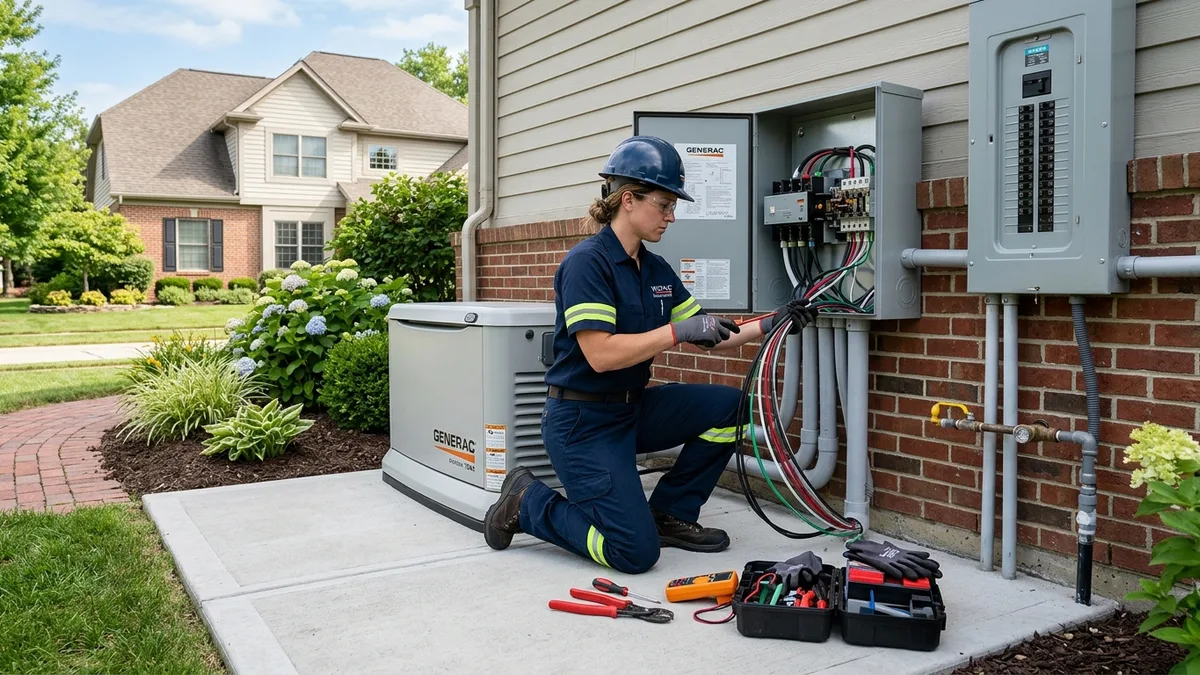
At Electrician Brighton CO, our field technicians specialize in turnkey Whole-Home Standby Generator Installations. Unlike loud, cumbersome portable gasoline generators that require manual outdoor pull-starting in freezing blizzards and hazardously backfeed through extension cords, a permanently installed automatic standby generator operates completely hands-free. Fueled by your existing natural gas line or an on-site liquid propane (LP) tank, a standby system continuously monitors utility grid voltage and automatically restores full electrical power to your property within 10 to 15 seconds of a blackout—whether you are sleeping soundly upstairs or away on vacation.
Technical Comparison: Portable Generator vs. Standby Generator with ATS
Understanding the operational and safety distinctions between portable and automatic backup solutions is critical for evaluating long-term reliability:
| Specification Parameter | Portable Gasoline Generator | Standby Generator with ATS (Whole-Home) |
|---|---|---|
| Fuel Delivery System | Manual Gasoline Cans (Stabilizer Required) | Continuous Natural Gas Line or Dedicated LP Tank |
| Starting Mechanism | Manual Pull Cord or Push-Button Start | Fully Automatic 10-Second Transfer Switch (ATS) |
| Power Output (kW) | 3 kW to 9 kW (Surge Limited) | 14 kW to 26 kW (Continuous Industrial Output) |
| Operational Hands-Free Status | Zero Automation; Requires Manual Outdoor Hookup | 100% Automated 24/7/365 Self-Testing and Transfer |
| Whole-Home Heat and Well Pump | Rare (Requires Multiple Heavy Cord Drops) | Full 240-Volt Support for HVAC and 3-Phase Well Pumps |
| Carbon Monoxide Safety | Severe Risk If Operated Near Open Windows/Eaves | Safe Outdoor NEMA 3R Placement with Exhaust Codes |
| Noise Profile | 74 to 85+ dBA (Loud Open-Frame Engine) | 58 to 66 dBA (Acoustic Insulated Sound Baffle) |
| Applicable Brighton Properties | Short-Term Tailgate / Light Emergency | Bromley Park Subdivisions and Todd Creek Acreage |
How an Automatic Standby Generator Operates
A permanently installed standby generator functions as an intelligent, automated microgrid for your property. The system consists of two primary hardware components working in tandem:
[ Utility Power Fails ] ──> [ ATS Senses Voltage Drop ] ──> [ Generator Engine Starts ] ──> [ ATS Switches Load to Generator ]
- Continuous Utility Voltage Sensing: The Automatic Transfer Switch (ATS) is installed directly between your main utility electric meter and your main electrical distribution panel. The ATS continuously samples incoming utility voltage from United Power or Xcel Energy.
- Instant Outage Detection: If incoming grid voltage drops below a calibrated threshold (typically 80% of nominal 240V) for more than three continuous seconds, the ATS microprocessor signals the generator engine to crank.
- Automated Transfer Under Load: Within 10 to 15 seconds, the generator engine starts, stabilizes at 3,600 RPM (producing clean 60-hertz AC electricity), and signals the transfer switch. The ATS mechanically disconnects the home from the utility grid and reconnects it to the generator supply. This physical double-throw mechanism prevents dangerous "utility backfeeding," protecting utility linemen working to repair downstream power lines.
- Utility Restoration and Cool-Down Cycle: When the utility grid stabilizes at normal voltage for five continuous minutes, the ATS smoothly shifts your household electrical circuits back to utility power. The generator engine then runs for a short two-minute unburdened cool-down cycle before shutting down and returning to standby monitoring mode.
- Scheduled Self-Testing: To ensure operational readiness, the generator executes an automated weekly exercise cycle (typically 5 to 12 minutes on a quiet low-RPM setting), circulating engine oil, charging its starting battery, and diagnosing internal sensors.
Sizing Your Generator: Essential Circuits vs. Whole-Home Systems
Selecting the correct generator kilowatt capacity requires an engineering load calculation under NEC Article 220:
1. Essential Circuit Backup Systems (14 kW to 18 kW)
For smaller suburban homes in neighborhoods like Bromley Park or Historic Downtown Brighton, an essential circuit system powers critical life-safety and comfort loads:
- Furnace blower motor and heating controls.
- Refrigerator, deep freezer, and kitchen small appliance circuits.
- Sump pump and security system.
- Home office, Wi-Fi router, and primary lighting circuits.
- Generator Capacity: Typically a 14kW to 18kW unit paired with a 16-circuit or 24-circuit load center.
2. Whole-Home Managed Backup Systems (20 kW to 26 kW)
For larger residences and homes with central air conditioning, induction cooktops, or electric hot water heaters, a whole-home system backed by smart load shedding modules provides complete peace of mind:
- Full coverage of all interior branch circuits.
- Automatic cycling of large 240-volt loads (such as electric heat strips or central AC compressors) to prevent generator stalling.
- Generator Capacity: A 20kW, 22kW, or 24kW generator paired with a 200-amp service-rated automatic transfer switch.
3. High-Capacity Estate and Semi-Rural Systems (26 kW to 48 kW Liquid-Cooled)
For expansive acreage estates in Todd Creek or agricultural properties featuring detached horse barns, heated workshops, and multi-horsepower domestic irrigation pumps:
- Dedicated support for 400-amp electrical services.
- Multi-cylinder automotive-grade liquid-cooled engines engineered for continuous high-amperage commercial-duty operation.
- Generator Capacity: A 26kW to 48kW liquid-cooled standby generator paired with dual 200-amp transfer switches.
Municipal Permitting, Gas Plumbing and 2023 NEC Compliance
Installing a whole-home standby generator in Brighton involves complex electrical and mechanical engineering governed by strict municipal codes:
Permitting Authority and Inspection Standards:
- Incorporated City of Brighton: Installations require joint electrical and mechanical/plumbing permits pulled through the City of Brighton Community Development Department (Building Division), located at 500 S 4th Ave, Brighton, CO 80601 (contact: 303-655-2017).
- Adams County and Weld County: Unincorporated properties fall under Adams County CEDD or Weld County Building Inspection.
- 2023 National Electrical Code Compliance:
- Article 702 (Optional Standby Systems): Governs transfer switch wiring, grounding electrode conductor sizing, and load management standards.
- Article 242 (Surge Protective Devices): Generators must be protected with whole-home surge suppression to shield generator stator windings and home electronics from utility switching spikes.
- NFPA 37 (Stationary Combustion Engines): Mandates that the generator must be placed at least five feet away from operable building openings (windows, doors, dryer vents) and at least five feet from combustible walls unless the enclosure is certified for closer clearance.
Natural Gas Pipe Sizing and Meter Upgrades:
A 22kW standby generator running at full electrical load consumes approximately 250 to 300 cubic feet per hour (CFH) of natural gas (250,000 to 300,000 BTUs). Older residential gas meters supplied by Xcel Energy are often rated for only 250 CFH total household demand. Our team calculates total connected gas load (furnace, water heater, range, fireplace, and generator) and coordinates directly with the utility to upgrade your gas meter to a high-capacity 400 CFH or 600 CFH unit, ensuring your furnace and generator never starve for fuel during winter blizzards.
Turnkey Installation Workflow
We handle every phase of your standby generator installation:
[ Electrical Load and Gas Calculation ] ──> [ Municipal Permitting ] ──> [ Concrete Pad and Conduit Run ] ──> [ ATS Installation and Utility Tie-In ] ──> [ Commissioning ]
- Site Assessment and Placement Planning: Our technicians determine optimal outdoor placement adhering to NFPA 37 clearances and noise ordinances, evaluate gas meter sizing, and inspect your main electrical panel. If your panel is an obsolete 100-amp unit, we can combine installation with a 200-amp electrical panel upgrade.
- Permitting and Utility Approvals: We file comprehensive engineering diagrams with the City of Brighton Building Division and submit required interconnection notices to United Power or Xcel Energy.
- Pad Preparation and Mechanical Placement: We pour a reinforced concrete slab or set a commercial-grade GenPad composite base, anchoring the generator securely against high plains Colorado winds.
- Electrical Transfer Switch and Conduit Installation: We mount the service-rated Automatic Transfer Switch, run heavy copper conductors through protective steel conduit, and plumb the gas line with flexible vibration dampers and manual shutoff valves.
- System Commissioning and Simulated Blackout Test: We perform oil and coolant servicing, program the weekly self-test schedule, cut utility power to execute a live simulated blackout, and verify that all household circuits transition seamlessly within 10 seconds.
For an extensive analysis of equipment tiers, installation labor, and gas plumbing costs, consult our whole-home generator cost guide.
Estimates are for budgeting purposes only. Actual prices vary based on on-site conditions, service amperage, conduit accessibility, and municipal permit requirements.
Frequently Asked Questions About Whole-Home Generators
How long can a standby generator run continuously during an extended outage?
As long as natural gas continues to flow from your utility service, a natural gas standby generator can run continuously for days or weeks. For liquid propane systems, run time depends on your on-site tank size; a standard 500-gallon LP tank filled to 80% capacity (400 gallons) can typically power a 20kW generator running under moderate household loads for 7 to 10 continuous days.
Will a standby generator damage sensitive computers or smart home electronics?
No. Modern commercial standby generators manufactured by brands like Generac, Kohler, and Cummins utilize advanced brushless alternators and digital voltage regulators that produce True Power Technology. Total Harmonic Distortion (THD) is kept below 5%, which is cleaner than standard utility grid electricity, making it completely safe for delicate microprocessors, medical devices, and smart TVs.
What regular maintenance does a standby generator require?
Like an automobile engine, a standby generator requires routine oil changes, oil filter replacements, spark plug inspections, and battery terminal cleaning. Standard preventative maintenance is recommended once per year or after every 100 to 200 hours of continuous runtime during an extended outage.
Secure Your Brighton Home with Reliable Backup Power Today
Do not wait for the next winter blizzard or severe Front Range storm to leave your property without heat, water, or light. Connect with our Brighton field dispatch desk today.
Call (720) 677-8240 to speak directly with an experienced standby power coordinator, or visit our contact page to request an itemized on-site project estimate.