Quick Key Takeaways – Whole-Home Surge Protection
Comprehensive Defense for Modern Electronics and Major Appliances
Modern residential households in Brighton, Colorado contain an unprecedented concentration of delicate microprocessors and solid-state electronics. From high-efficiency variable-speed inverter air conditioners and heat pumps to smart refrigerators, touch-screen induction cooktops, EV chargers, home automation hubs, and computers, the average modern home houses over $15,000 to $25,000 worth of sensitive electrical equipment.
Yet, despite this massive investment in sophisticated electronic infrastructure, thousands of homes across Adams County and Southern Weld County remain completely unprotected against the silent, destructive impact of electrical power surges.
While many property owners assume that plugging a computer or television into a $15 retail power strip provides adequate surge protection, this is a dangerous misconception. Plug-in strips provide minimal point-of-use absorption and leave your home's most expensive mechanical systems—including central air conditioning compressors, furnaces, tankless water heaters, washers, and dryers—completely exposed to incoming electrical transients.
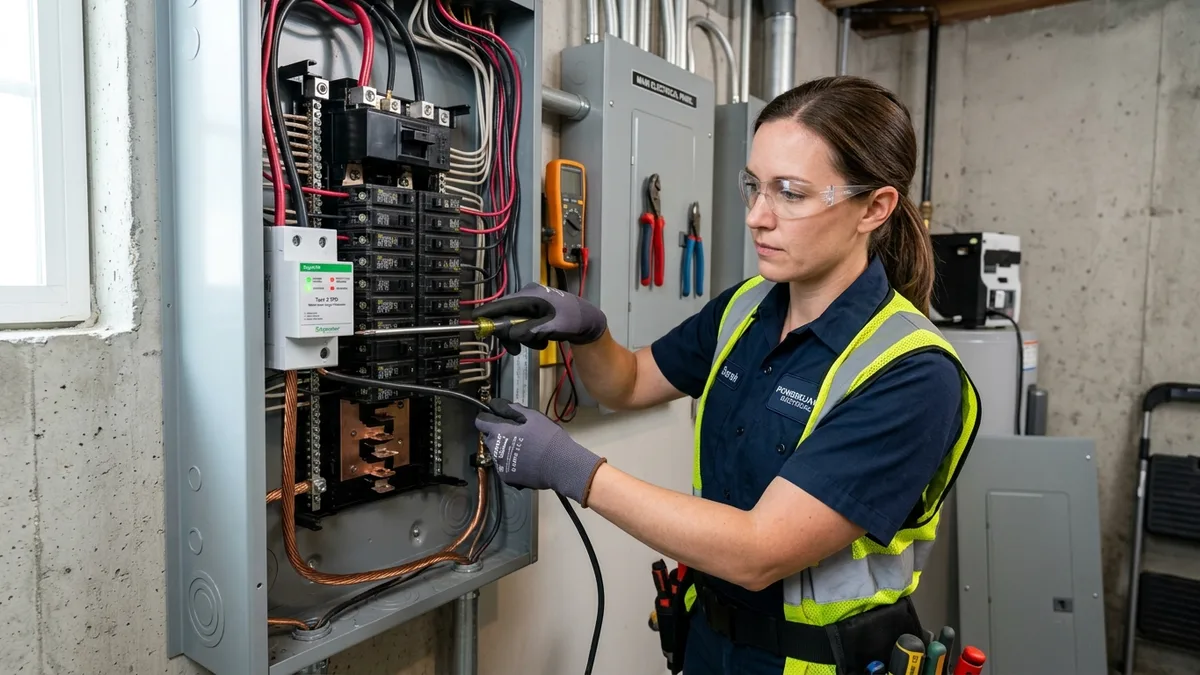
At Electrician Brighton CO, our field technicians install commercial-grade Type 1 and Type 2 Whole-Home Surge Protective Devices (SPDs). Mounted directly at your main electrical service panel, a whole-home SPD acts as an automated protective barrier, intercepting high-voltage spikes at the point of entry and safely diverting thousands of amps of transient energy harmlessly into your home's grounding electrode system in nanoseconds.
The Anatomy of Electrical Surges in Colorado
An electrical surge—technically classified as a transient overvoltage—is an intense, momentary spike in electrical voltage that substantially exceeds the standard 120-volt or 240-volt alternating current (AC) waveform delivered by your utility provider. While standard household circuits operate at nominal 120 volts (peaking naturally around 170 volts peak-to-peak), a power surge can inject spikes ranging from 500 volts to over 10,000 volts into your home's branch wiring.
Surges originate from both external and internal sources:
1. External Surges: Front Range Lightning and Grid Utility Switching (20% of Surges)
Colorado's high plains environment along the Front Range experiences severe atmospheric electrical activity. During intense summer convective thunderstorms, cloud-to-ground lightning strikes hitting nearby utility distribution lines can send massive transient surges of tens of thousands of volts traveling through neighborhood power lines directly into residential meters. Furthermore, routine grid switching by regional utilities—such as United Power or Xcel Energy re-routing power around damaged substations or clearing line faults caused by high plains winds—produces severe inductive spikes that enter residential panels.
2. Internal Surges: Major Motor Cycling (80% of Surges)
Contrary to common belief, roughly 80% of all electrical surges originate inside your own home. Every time a high-draw inductive mechanical load turns on or off—such as a 3-ton central air conditioning condenser, a heat pump blower, a refrigerator compressor, or a vacuum cleaner motor—the collapsing magnetic field in the motor windings discharges a back-EMF voltage spike into your household branch wiring. While individual internal surges are smaller (typically 300 to 1,500 volts), their cumulative frequency (occurring dozens of times per day) gradually degrades the delicate silicon microprocessors inside your smart appliances, causing premature circuit board failure.
Technical Comparison: SPD Tiers Under UL 1449
Surge protective devices are classified under UL 1449 (Standard for Surge Protective Devices) into three distinct functional tiers:
| SPD Classification | Installation Location | Primary Surge Target | Typical Discharge Current (kA) | Protection Scope |
|---|---|---|---|---|
| Type 1 SPD | Line-side of Main Disconnect (Outdoor Meter-Main) | External Lightning and Grid Utility Switching | 50 kA to 100 kA Per Phase | Entire Property and Main Electrical Panel |
| Type 2 SPD | Load-side of Main Breaker (Inside Branch Panel) | Residual Grid Spikes and Major Internal Surges | 25 kA to 50 kA Per Phase | All Branch Circuits, HVAC and Major Appliances |
| Type 3 SPD | Point-of-Use Wall Outlet (Plug-in Strips) | Minor Localized Equipment Transients | 1 kA to 10 kA Total | Dedicated Plug-In Device (TV, Computer) |
The 2023 National Electrical Code Mandate (NEC Article 242)
The risk of surge damage to modern residential equipment is so acute that the National Fire Protection Association introduced mandatory surge protection requirements in recent code cycles.
Enacted statewide across Colorado by the Colorado State Electrical Board under DORA, and enforced locally by the City of Brighton Community Development Department (500 S 4th Ave, Brighton, CO 80601), 2023 National Electrical Code Article 242 (Overvoltage Protection) mandates:
- Mandatory Installation on All Services: All new residential service panels, panel replacements, and 200-amp service heavy-ups must be equipped with an approved Type 1 or Type 2 Surge Protective Device.
- Integral or Adjacent Mounting: The SPD must be an integral component of the service equipment or mounted directly adjacent to the panel enclosure with the shortest possible conductor leads to minimize inductive lead-length impedance.
- UL 1449 Listing: The surge protector must carry official UL 1449 certification and feature a nominal discharge current rating (In) of at least 10 kiloamps (kA) or higher.
When our technicians execute an electrical panel upgrade or emergency electrical repair, we ensure full compliance with NEC Article 242, certifying your installation with municipal building inspectors.
The Concept of Cascaded Two-Tier Surge Defense
Achieving true whole-home electronic protection requires an engineered "cascaded" or layered defense strategy. No single device can eliminate 100% of high-voltage surge energy:
[ Incoming Utility Grid Surge ] ──> [ Tier 1: Panel SPD Clamps 90%+ ] ──> [ Tier 2: Point-of-Use Strip Absorbs Residual ]
- Tier 1: Main Panel Heavy Protection (Type 1 or Type 2 SPD): Installed at your main breaker box, this device acts as the primary gatekeeper. Utilizing heavy metal-oxide varistors (MOVs) and gas discharge tubes, it intercepts high-voltage transients from lightning or utility switching, absorbing and shunting 90% or more of the surge energy directly into the grounding electrode system before it can enter branch circuits.
- Tier 2: Point-of-Use Secondary Protection (Type 3 Plug-In Strips): While the main panel SPD clamps the primary spike down to safe residual levels, delicate microprocessors in home computers, gaming consoles, and home theater audio equipment benefit from a quality Type 3 plug-in strip at the wall outlet to absorb any lingering low-voltage ringing transients.
By combining a commercial-grade whole-home SPD with localized point-of-use strips, you establish an airtight surge defense matrix across your entire residence.
How Our Technicians Install Whole-Home Surge Protection
Installing an SPD requires precise electrical engineering to ensure fast response times:
- Panel Evaluation and Breaker Slot Allocation: Our technician inspects your service panel, ensuring bus bar compatibility and identifying the optimal mounting location. Because surge energy travels at the speed of light along the path of least resistance, the SPD must be connected as close as physically possible to the main incoming service lugs.
- Dedicated Double-Pole Breaker Installation: We install a dedicated 20-amp or 30-amp dual-pole circuit breaker replacement directly adjacent to the main breaker to feed the SPD.
- Lead Length Optimization: The technician trims the SPD's phase, neutral, and ground conductors to the shortest possible straight run without sharp 90-degree bends. Minimizing conductor length is critical; every additional inch of wire adds inductive impedance that slows down the SPD's response time during a microsecond lightning strike.
- Diagnostic Status Verification: Once energized, we verify that the unit's dual LED diagnostic indicators illuminate green, confirming active phase-to-neutral and phase-to-ground protection. Many commercial units also feature audible alarms that notify homeowners in the event that an extraordinary surge event has sacrificed the internal varistors.
If your property also features a backup generator, explore our whole-home standby generator installations to see how SPDs protect generator transfer switch electronics during utility outages.
Transparent Whole-Home Surge Protection Pricing Factors
Installing a commercial-grade whole-home surge protective device is one of the most cost-effective investments a Brighton homeowner can make:
- Type 2 Panel-Mounted Surge Protector Installation: Installing a commercial-grade Square D, Eaton, or Siemens 50kA-per-phase Type 2 SPD into an existing compatible 200-amp panel typically ranges from $350 to $650, including hardware, dedicated double-pole breaker, and certified installation.
- Combined Installation During a Panel Upgrade: If you are already upgrading your main electrical panel to 200 amps, the surge protective device is integrated directly into the new enclosure, often reducing total standalone installation costs.
- Heavy-Duty Type 1 Meter-Main Exterior SPD: Installing an outdoor NEMA 4X rated Type 1 surge suppressor on an exterior meter-main combination box ranges from $450 to $750.
Estimates are for budgeting purposes only. Actual prices vary based on on-site conditions, service amperage, conduit accessibility, and municipal permit requirements.
Frequently Asked Questions About Whole-Home Surge Protection
How does a whole-home surge protector actually stop a power surge?
A whole-home SPD utilizes advanced electronic components called Metal-Oxide Varistors (MOVs). Under standard 120V/240V operating voltages, the MOVs have extremely high electrical resistance and act as an open switch, allowing normal electricity to flow to your appliances. However, when a high-voltage surge enters the panel, the MOVs react in less than a nanosecond, their resistance drops to near zero, and they safely divert the excess electrical current into your home's ground wire and outdoor grounding rods.
Does a whole-home surge protector need to be replaced after a storm?
Commercial-grade whole-home SPDs are engineered to absorb hundreds of minor daily power surges without degrading. However, during a massive nearby lightning strike, the internal varistors may sacrifice themselves to save your home's wiring and appliances. All units installed by our team feature clear LED diagnostic status lights; as long as the status lights remain green, the unit is actively protecting your home. If a status light extinguishes, the device has absorbed its maximum capacity and requires replacement.
Will a surge protector protect my home if it doesn't have proper grounding rods?
No. A surge protector cannot function without a low-impedance path to earth. The device works by diverting excess electrical current to your home's grounding electrode system. If your home has loose ground clamps, corroded ground rods, or missing bond wires, the surge energy has nowhere to go and will flash over into household appliances. When our technicians install an SPD, we inspect and test your grounding electrode conductors to guarantee safe, effective surge dissipation.
Shield Your Brighton Home's Appliances and Electronics Today
Do not wait for a summer Front Range lightning storm or unexpected utility grid surge to destroy your HVAC system, refrigerator, or home electronics. Connect with our field dispatch desk today.
Call (720) 677-8240 to schedule your whole-home surge protector installation, or visit our contact page to request an itemized project estimate.