Quick Key Takeaways – Ceiling Fan Installation
Energy-Efficient Air Circulation and Year-Round Comfort in Brighton
During the hot, dry summer months along the high plains of Colorado, outdoor temperatures in Brighton regularly climb into the mid-90s and triple digits. While central air conditioning provides essential whole-home refrigeration, running an AC compressor continuously during peak afternoon heat waves places heavy electrical demands on your service panel and drives up monthly utility bills from United Power or Xcel Energy.
A properly sized, professionally balanced ceiling fan creates a gentle, continuous breeze that produces an evaporative "wind-chill" cooling effect on human skin. Operating a ceiling fan allows homeowners to raise their central air conditioning thermostat by 4 degrees Fahrenheit with zero loss in perceived indoor comfort, slashing cooling energy consumption by up to 12% to 15%.
Conversely, during cold Colorado winters, heated air naturally rises and collects in the upper peaks of high vaulted ceilings and second-story stairwells, leaving lower living areas drafty and cold. By reversing a ceiling fan's rotational direction to a clockwise updraft, the fan gently pushes trapped ceiling heat downward along outer walls, redistributing warmth without creating an uncomfortable draft.
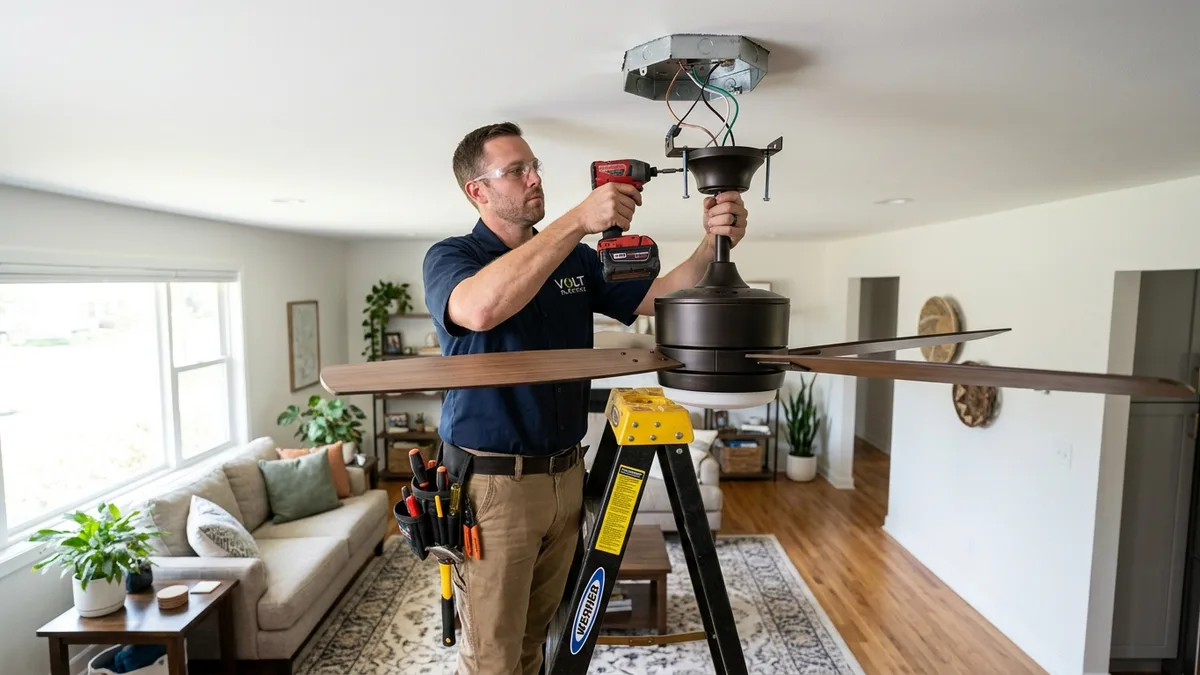
At Electrician Brighton CO, our field technicians provide complete Ceiling Fan Installation, Replacement, and Structural Bracing Services. From replacing standard builder-grade plastic light boxes with heavy-duty UL-listed steel fan-rated junction boxes to installing custom long downrods on two-story vaulted ceilings in Bromley Park and wiring smart dual-wall controls, we guarantee wobble-free, whisper-quiet performance.
The Critical Importance of UL-Listed Fan-Rated Junction Boxes
The single most dangerous hazard in DIY or handyman ceiling fan installation is mounting a ceiling fan directly to a pre-existing standard plastic or light-duty metal ceiling light box.
The Structural Physics of Ceiling Fan Mounting:
Under the 2023 National Electrical Code (NEC Article 314.27(C)), any junction box intended to support a ceiling-suspended paddle fan must be specifically listed and marked by an accredited testing laboratory (such as Underwriters Laboratories - UL) as "Acceptable for Fan Support".
- Static vs. Dynamic Mechanical Load: A standard lighting fixture hangs completely motionless, exerting only static downward gravitational force. Standard round plastic ceiling boxes are rated for a maximum static fixture weight of 50 pounds. However, a ceiling fan represents a dynamic, rotating mechanical load. As the electric motor spins heavy blades at 150 to 220 RPM, it introduces continuous vibrational torque and centrifugal oscillation.
- Fatigue and Catastrophic Box Failure: If a ceiling fan is secured to a non-fan-rated plastic box, the cyclic vibration causes the thin 8-32 machine screw threads or plastic mounting ears to fatigue, crack, and strip out over time. Eventually, the entire rotating fan assembly can tear free from the ceiling, crashing down onto furniture or room occupants.
- Our Safety Protocol: Whenever our technicians install a ceiling fan in place of an existing light fixture, we inspect the ceiling box framing. If a non-fan-rated box is present, we remove it and install an expandable steel fan brace that anchors securely between the ceiling joists with heavy-duty lag bolts, rated to safely support dynamic fan loads of 70 pounds or more.
Technical Comparison: Fan-Rated Boxes vs. Standard Light Boxes
Review the critical structural differences below:
| Technical Parameter | Standard Ceiling Light Box | Heavy-Duty Fan-Rated Steel Box and Brace |
|---|---|---|
| Material Construction | Injection-Molded Thermoplastic or Light Stamped Steel | Heavy Gauge Galvanized Steel with Solid Welded Ears |
| UL Rating Marking | Marked "For Fixture Support Max 50 lbs" |
Explicitly Stamped "Acceptable for Fan Support 70 lbs+" |
| Mounting Hardware | Small #8-32 Machine Screws | Heavy #10-24 or #10-32 Grade-5 Hardened Steel Screws |
| Joist Attachment | Direct Nail into Single Joist | Expanding Steel Spreader Bar Gripping Dual Joists |
| Dynamic Vibration Resistance | Poor; Prone to Fatigue Cracking | Excellent; Absorbs Motor Torque and Centrifugal Wobble |
| Code Compliance Status | Violation If Supporting Ceiling Fan (NEC 314.27(C)) | 100% Fully Compliant with 2023 National Electrical Code |
Seasonal Airflow Dynamics: Optimizing Your Fan Year-Round
Many homeowners are unaware that modern ceiling fans are engineered for dual-season functionality through a reversible motor switch located on the motor housing or via a handheld remote control:
1. Summer Mode: Counter-Clockwise Rotation (Downward Cooling Breeze)
When looking up at the ceiling fan from below, the blades should rotate in a counter-clockwise direction. In this mode, the angled pitch of the fan blades forces air straight downward, creating an active cooling column directly beneath the fixture. The moving air accelerates the evaporation of moisture from your skin, making an 78-degree room feel like 74 degrees.
2. Winter Mode: Clockwise Rotation (Gentle Updraft Heat Redistribution)
When winter snowstorms blanket Brighton and your furnace kicks on, heated air rises to the highest point in the room. Switch the fan motor to rotate in a clockwise direction at the lowest speed setting. In clockwise rotation, the blades draw cool air upward toward the ceiling, displacing the trapped warm air and pushing it outward along the ceiling and down the perimeter walls. This eliminates hot ceiling pockets and circulates warmth to floor level without creating a wind-chill effect.
Vaulted, Cathedral and High-Ceiling Installations
Many contemporary homes in Brighton feature dramatic two-story vaulted great rooms, architectural cathedral ceilings, or open lofts with ceiling heights ranging from 12 to 20 feet. Installing a ceiling fan in these high-volume spaces requires specialized hardware and downrod length calculations:
Calculating the Correct Downrod Length:
For optimal aerodynamic efficiency and personnel safety, ceiling fan blades should hang between 8 feet and 9 feet above the finished floor surface. Hanging a fan too close to a high ceiling traps air circulation in the upper room volume, while hanging it too low creates head-clearance hazards.
We calculate required downrod lengths based on ceiling height:
- 9-Foot Ceiling: 12-inch downrod.
- 10-Foot Ceiling: 18-inch downrod.
- 12-Foot Ceiling: 24-inch to 36-inch downrod.
- 14-Foot Ceiling: 48-inch downrod.
- 16-Foot+ Ceiling: 60-inch to 72-inch heavy-gauge steel downrod.
Sloped Ceiling Canopy Kits:
Standard ceiling fan ball hangers can accommodate slopes up to 20 or 25 degrees. For steeply pitched cathedral ceilings exceeding 30 to 45 degrees, our technicians install specialized vaulted ceiling canopy adapters that allow the downrod to hang plumb without binding against the ceiling canopy trim ring.
Control Options: Dual Wall Switches, Remotes and Smart Integration
Operating your ceiling fan should be intuitive and convenient. We offer multiple wiring and control configurations:
- Dual Wall Switches (Independent Fan and Light Control): If your ceiling junction box contains 3-wire Romex cable (black, red, white, ground), we wire dedicated wall switches—one slider switch to adjust fan motor speeds (low, medium, high) and a separate digital dimmer to adjust the light kit. This eliminates unsightly dangling pull chains. For wall control upgrades, explore our outlet and switch installation services.
- Handheld Wireless Remotes: For installations where pulling new 3-wire cable through finished walls is impractical, we install a compact remote control receiver inside the fan canopy, allowing you to control motor speeds and dimming from a handheld wireless remote or bedside wall cradle.
- Smart Wi-Fi and Voice Automation: We install smart ceiling fan controls (such as Lutron Caseta or Hunter SimpleConnect) that integrate with your home Wi-Fi network, allowing you to schedule airflow, automate temperature-triggered activation, and control your fan via smartphone or voice assistants.
Precision Dynamic Balancing: Eliminating Wobble and Motor Hum
A wobbling, squeaking, or clicking ceiling fan is more than an annoyance; continuous mechanical wobble places cyclic stress on the ceiling mounting bracket and can eventually loosen electrical wire connectors.
Our Dynamic Balancing Procedure:
- Blade Weight Matching: We use digital gram scales to verify that all fan blades are balanced within precise weight tolerances.
- Blade Alignment and Pitch Verification: We measure the vertical distance from the tip of each blade to the ceiling, ensuring that all blade irons maintain identical pitch angles.
- Counterweight Balancing: Using professional balancing clips and adhesive lead counterweights, we dynamically tune the fan motor at high speed until all mechanical oscillation is completely eliminated, ensuring whisper-quiet operation.
For exterior covered patios, gazebos, or outdoor porches, we install UL-listed Damp-Rated and Wet-Rated Outdoor Ceiling Fans engineered with sealed ABS plastic blades and moisture-proof motor windings that resist humidity, blowing dust, and high plains winds.
Transparent Ceiling Fan Installation Pricing Factors
Ceiling fan installation is a fast, high-impact service that delivers immediate comfort:
- Standard Ceiling Fan Replacement (Existing Fan-Rated Box, 8-9 Ft Ceilings): Assembling and installing a customer-supplied ceiling fan onto an existing compliant junction box typically ranges from $180 to $320.
- Fan-Rated Box Retrofit with Structural Steel Brace: Removing an older plastic light box and installing an expandable UL-listed steel ceiling fan brace between joists ranges from $150 to $250 additional.
- High Vaulted Ceiling Installation (12+ Feet): Installing a ceiling fan on a high or steeply pitched ceiling requiring scaffolding or specialized tall ladders, downrod assembly, and slope canopy kits ranges from $350 to $650.
- New Circuit Run (No Pre-Existing Ceiling Box): Running a new switch leg and ceiling circuit from an existing room branch circuit ranges from $350 to $700. If your main panel requires additional breaker capacity, review our circuit breaker repair options.
Estimates are for budgeting purposes only. Actual prices vary based on on-site conditions, service amperage, conduit accessibility, and municipal permit requirements.
Frequently Asked Questions About Ceiling Fans
Can I install a ceiling fan in a room with an 8-foot ceiling?
Yes. For rooms with standard 8-foot ceilings, we recommend installing a low-profile "hugger" or flush-mount ceiling fan. These fixtures mount directly against the ceiling without a downrod, ensuring the fan blades maintain the code-mandated minimum clearance of 7 feet above the finished floor.
Why does my new ceiling fan make a clicking or humming noise?
A humming sound is typically caused by motor harmonic distortion, which often occurs when a ceiling fan is connected to an incompatible wall dimmer switch designed for lighting rather than fan motors. A rhythmic clicking noise is usually caused by loose blade screws, unseated canopy trim rings, or internal wire harnesses rubbing against the rotating motor flywheel. Our technicians isolate and eliminate mechanical noise points during installation.
How much weight can a fan-rated electrical box support?
Under National Electrical Code standards, a properly installed UL-listed fan-rated electrical box and heavy-duty steel mounting brace is rated to support a rotating ceiling fan weighing up to 70 pounds, or a static light fixture weighing up to 150 pounds. This provides a massive safety factor for standard residential ceiling fans, which typically weigh between 15 and 35 pounds.
Upgrade Your Brighton Home's Comfort with Precision Ceiling Fans Today
Enjoy whisper-quiet airflow, lower summer cooling bills, and year-round temperature balance. Connect with our local Brighton field dispatch team today.
Call (720) 677-8240 to speak directly with an experienced coordinator, or visit our contact page to request an itemized project estimate.